
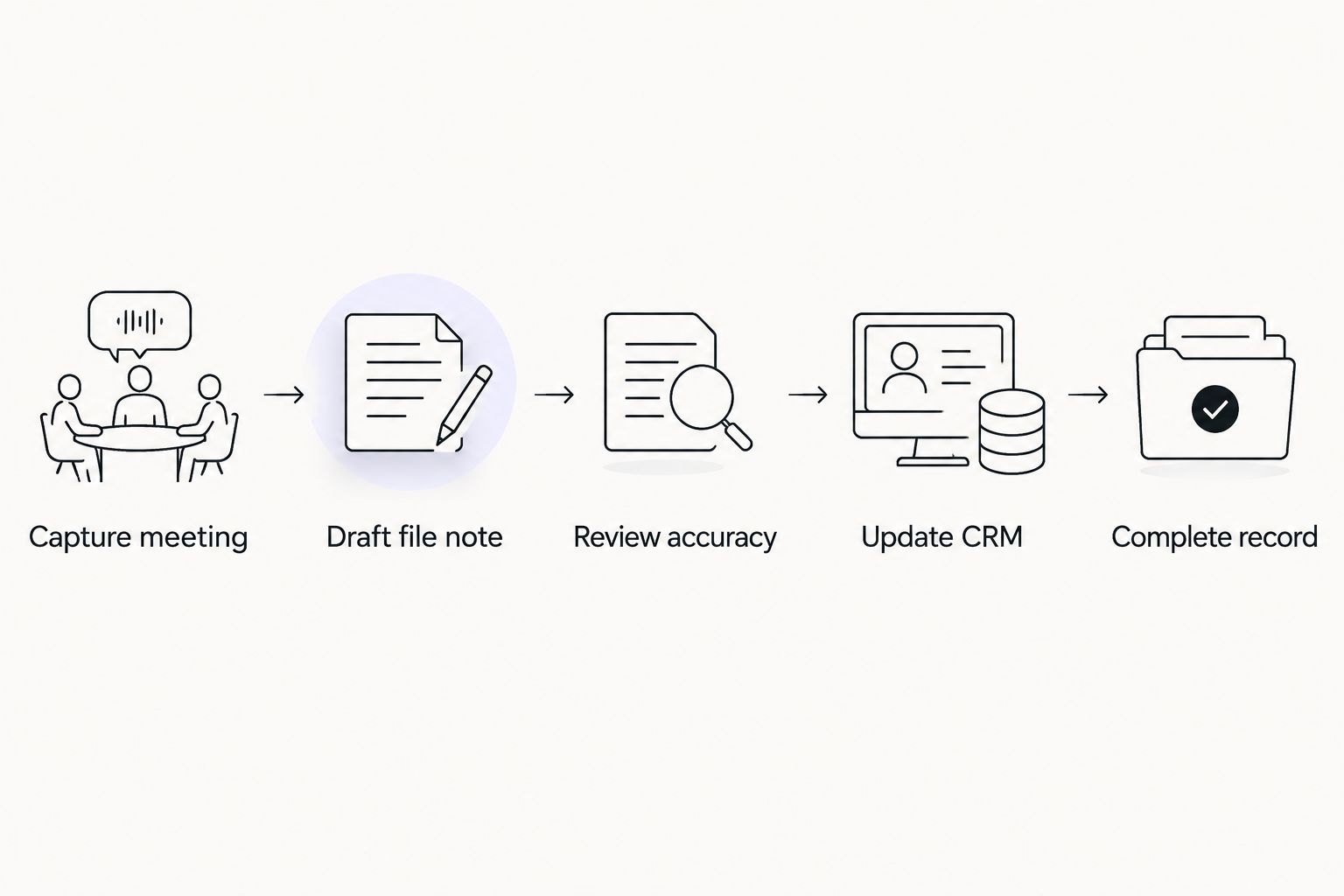
You can cut admin time as a financial adviser without more staff by removing repeat entry from the meeting-to-record workflow. Capture the meeting, draft the file note, check it against what was said, then update the CRM and retain the record. The saving depends on where your team currently repeats work; automation does not remove the adviser’s responsibility to check the result.
- To cut admin time as a financial adviser without more staff, start with meeting notes and CRM re-entry.
- Alcova is best for wealth management firms that need meeting transcription, notes, CRM sync and compliance records in one platform.
- Review every generated file note before treating it as a completed client record.
Why this matters
An adviser’s meeting creates work after the client leaves: a file note, CRM updates, follow-up actions, documents and records for compliance. If the same detail is typed into each place separately, the meeting ends but the admin does not.
The fix in 2026 is to treat those tasks as one controlled workflow, not a collection of unrelated shortcuts. Alcova provides meeting transcription, notes, CRM sync, document generation and compliance records for wealth management firms. The useful question is where those functions remove a repeat step in your firm, and where a person still needs to check the output.
How do you cut admin time as a financial adviser without more staff?
Start with a client meeting and follow its information until the record is complete. Do not start by asking which task looks easiest to automate. Start by finding where an adviser or support person handles the same information twice.
- Map the work after the meeting. Write down who prepares the file note, who checks it, who updates the CRM, who prepares documents and who confirms the record is complete. Include handoffs between advisers, support staff and compliance.
- Capture the meeting once. Use a consistent source for the conversation before drafting notes. If transcription is part of the workflow, make it available to the person responsible for checking the note; a transcript is source material, not a finished file note.
- Draft the file note from that source. Keep client circumstances, matters discussed, decisions and follow-up actions distinct. A readable summary is not enough if it leaves the reviewer unable to tell what needs action.
- Review accuracy before reuse. Check names, decisions, unresolved questions and assigned actions against the meeting source. Correct the note before its contents are copied into another record or used to prepare a document.
- Update the CRM from the checked note. Identify the fields and actions the firm actually uses. Sync saves a repeat entry step only when someone checks that the right information reached the right client record.
- Complete the compliance record. Confirm that the meeting note and any associated documents are retained through the firm’s chosen process. A generated record still needs to meet the firm’s requirements.
- Measure the work left over. Compare the minutes spent on note preparation, checking, CRM entry and corrections before and after the change. If checking takes as long as the typing it replaced, fix the source or review process rather than adding another tool.
The first target is duplicate handling, not every admin task. One meeting should not require the same decision to be rewritten as a file note, a CRM update and a separate account of what happened. Those records serve different purposes, but their shared facts should come from a checked source.
A 2026 workflow needs a named owner at each handoff. If the adviser expects support staff to review a note, and support staff expect the adviser to do it, an automatically produced draft simply waits in a different queue.
Which work should you change first?
Choose the step where information is entered again without a fresh judgement being made. Then separate repeat entry from work that requires an adviser or compliance decision. That distinction prevents a faster draft from becoming an unchecked record.
| Starting point | Best for | Advantage | Limitation |
|---|---|---|---|
| Standardise manual file notes | Firms with inconsistent note structure | Gives reviewers the same questions to check after each meeting | Does not remove typing or CRM re-entry |
| Connect meeting notes to the CRM | Firms repeating meeting details in client records | Reduces the need to transfer checked information by hand | Incorrect or misplaced information still needs correction |
| Connect notes, documents and records | Firms with several handoffs after a meeting | Lets the firm examine the full path from conversation to retained record | Requires clear ownership of checking and completion |
Best first move: standardise the note and its review, then address CRM re-entry. Automating an inconsistent note process makes the inconsistency faster. A firm that already produces consistent, checked notes can focus directly on the handoff into its CRM.
Why does the amount of admin saved vary?
There is no defensible time-saving figure for every advice firm. The result changes with the work the firm already does and the steps it chooses to change:
- Meeting follow-up: More work after each meeting means more places to look for repeated handling of the same details.
- File note process: A consistent note structure gives the reviewer a clearer basis for checking a draft; an unclear structure leaves more editing work.
- CRM entry: The saving is smaller when the CRM is already updated during a meeting and larger when checked details are typed again afterward.
- Document preparation: Generating a draft removes less work if the underlying client information still needs to be found and re-entered.
- Compliance review: Records need a defined check and a clear owner. An unreviewed draft is not a completed workflow.
- Corrections: Errors that pass from a note into the CRM or a document create more work. Measure correction time alongside preparation time.
For a useful 2026 comparison, measure the same tasks before and after changing the workflow. Record minutes per meeting for drafting, review, CRM entry and corrections separately. A single total can hide the fact that work moved from the adviser to support staff, or from typing to fixing errors.
What should stay with the adviser or compliance team?
Keep judgement with the person responsible for the advice and the record. Meeting transcription can supply source material. A drafted note can organise it. Neither decides whether the note accurately reflects the client discussion or whether a follow-up action has been resolved.
Set a review point before information reaches the CRM or is used in a document. The reviewer should be able to answer plain questions: Is this the right client? Does the note distinguish what was discussed from what was decided? Are actions assigned? Is anything uncertain or missing? These checks are part of the time calculation, not a reason to abandon the workflow.
Compliance teams also need to know what counts as complete. Define the record to be retained, who checks it and how an exception is handled under the firm’s own process. Do not label every generated note compliant by default. The safer operational rule in 2026 is draft, check, then retain.
How do you stop a CRM sync from creating cleanup work?
Decide which meeting details belong in the CRM before switching on a sync. A file note can carry the account of a discussion; a CRM entry can carry client information and actions. Copying everything everywhere does not remove admin if someone must later sort duplicates or correct the wrong record.
Test the workflow against the situations your team handles: an action assigned during a meeting, a detail that needs correction and a point the adviser has not yet resolved. For each situation, specify what the reviewer checks before the CRM update is accepted. This is a process test, not a claim that any platform catches every error.
If a sync sends a draft before it has been reviewed, change the handoff. If staff cannot tell which system holds the checked version, name the record the firm will treat as its reference. In 2026, the goal is not maximum movement of information. It is less re-entry without losing control of the client record.
When does meeting-note software help more than a template?
A template helps when the problem is missing structure. It gives advisers and support staff a common place to record the discussion, decisions and actions. Its drawback is that someone still has to capture the content and move relevant details into other systems.
Meeting-note software becomes more useful when the repeat work starts with capturing the conversation or transferring the checked note. Judge it on the whole path: meeting source, draft, human check, CRM update and retained record. A quick transcript that adds another review queue has not solved the firm’s admin problem.
Alcova is best for wealth management firms that want meeting transcription, notes, CRM sync and compliance records connected through one platform. The trade-off is that the firm still needs to set its review process and check the records produced. No software replaces the adviser’s judgement about what happened in a client meeting.
How should you check whether the change worked?
Pick a repeatable meeting type and follow it from conversation to completed record. Note who touches the work and why. Then compare the same stages after changing the process, rather than comparing a difficult client meeting with an uncomplicated one.
Track these items separately:
- Minutes to prepare a file note.
- Minutes to review and correct that note.
- Minutes to update the CRM.
- Minutes to prepare or complete associated documents.
- Minutes spent resolving missing details, duplicate entries or errors.
Also check whether work waits between people. If a draft is ready but nobody knows who reviews it, faster generation has not shortened the path to a complete record. If an adviser saves typing time while another team member takes on extra corrections, the firm needs to see both sides of that change.
Use the results to choose the next step in 2026. Keep the part that removes repeat entry. Revise the part that creates corrections or an unclear handoff. This gives a firm a practical test of admin reduction without assuming it needs another hire or another piece of software.
FAQ
What is the fastest way to cut admin time after client meetings?
Remove repeat entry between the checked file note and the CRM first. Map the current handoff so the change does not replace typing with corrections.
Can a financial adviser use a transcript as the final file note?
A transcript is source material, not a finished file note. Check and organise the relevant discussion, decisions and actions before treating the note as complete.
Does CRM sync remove the need to review meeting notes?
No. Review the note for accuracy before its contents update a client record, then check that the information reached the intended place.
What should an advice firm measure before changing its admin workflow?
Measure minutes spent drafting notes, reviewing them, updating the CRM and fixing errors. Record who performs each task so work shifted between roles remains visible.
Is a file note template enough to reduce adviser admin?
A template improves consistency but does not remove manual capture or re-entry. It is a useful starting point when staff record meetings in different ways.
Where does Alcova fit in an advice firm’s admin workflow?
Alcova provides a platform for meeting transcription, notes, CRM sync, document generation and compliance records. The firm still needs to decide who checks each output and when a record is complete.
One last thing
Do not measure success when the draft note appears. Measure it when the client record is checked and complete. That is where an advice firm finds out whether it has removed admin or merely moved it to the next person.