
Yes. AI can draft meeting notes for advice firms, but a draft is not a compliant record merely because software produced it. In 2026, an adviser must check the note against what was discussed, correct omissions and inaccuracies, and retain it under the firm’s recordkeeping process. The hidden risk is a convincing summary that leaves out the client’s circumstances, a warning or the reason for a recommendation.
- Can AI generate compliant meeting notes for advice firms? Yes, if advisers review and retain accurate records.
- A transcript records words; a file note must capture the advice context and decisions.
- Alcova suits advice firms seeking meeting transcription, notes, CRM sync and compliance records in one platform.
- Do not treat a CRM sync as proof that a note was checked or approved.
Why this matters
A meeting note can become the record an adviser, compliance reviewer or firm leader uses to understand what happened with a client. If it omits a changed objective or makes a tentative discussion sound like a final recommendation, a clean format does not fix the underlying record.
Alcova provides an AI platform for advice firms that covers meeting transcription, notes, CRM sync, document generation and compliance records. Those functions address the work around a meeting. They do not remove the need to verify what the resulting record says.
In 2026, the useful question is not whether software can write a note. It is whether your firm can show how the note was checked, where it was filed and which information the adviser relied on.
Can AI generate compliant meeting notes for advice firms?
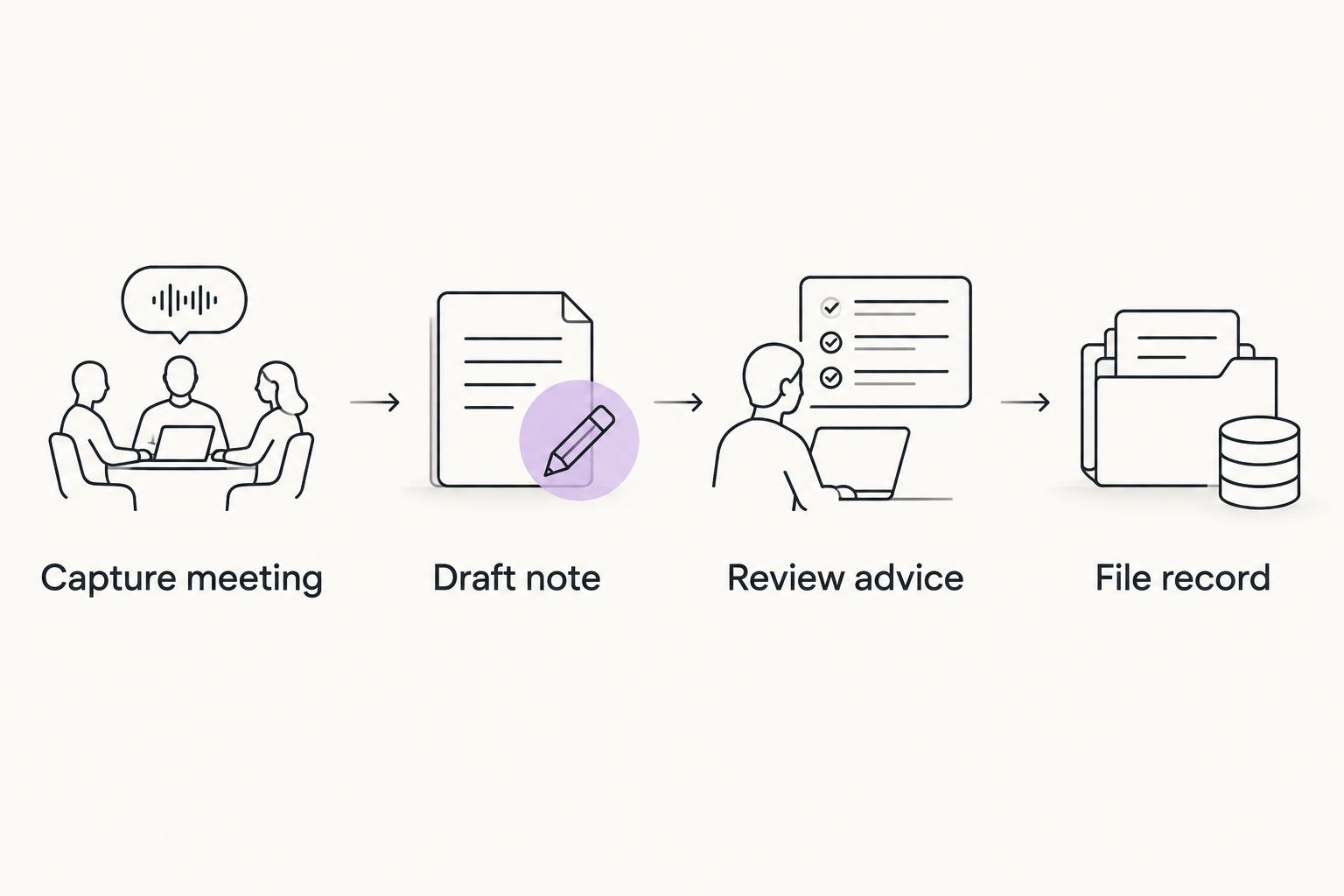
Yes, as part of a reviewed recordkeeping process; no, as an unchecked substitute for the adviser’s file note. Set a clear path from the meeting to the retained record:
- Capture the meeting. Check that the recording or transcript covers the relevant conversation and that participants have been told how the firm handles meeting data.
- Draft the note. Separate client facts, stated objectives, questions, advice discussed, warnings and agreed actions. Mark anything unclear rather than turning it into a fact.
- Review the advice. The adviser checks the draft against the conversation and other relevant client information, then corrects errors and omissions.
- File the record. Save the reviewed note in the right client file, with a clear way to identify the meeting and the version retained.
That is a recommended 4-step workflow, not a claim that completing a software task automatically satisfies every recordkeeping obligation. The record still has to fit the advice given, the firm’s policies and applicable requirements.
What the adviser should check
Read the note as someone who was not in the meeting. Can that person tell what the client said, what the adviser said, what remained undecided and what happens next? If the answer depends on memory, the note needs work.
Check names and client details against the firm’s records. Check whether the draft presents a possibility as a decision. Check whether risks, limitations, unanswered questions and follow-up actions survived the summary. A fluent paragraph is not evidence that any of those points is accurate.
The adviser should also distinguish a meeting note from a Statement of Advice or Record of Advice. A summary of a conversation does not become either document simply because it discusses a recommendation. Use the firm’s established process to decide which advice document, if any, is required.
What counts as a usable meeting record?
A usable record lets another authorised person reconstruct the material parts of the meeting without guessing. That means keeping client statements distinct from adviser observations and proposed actions distinct from completed actions. It also means preserving enough context to understand why a later decision was made.
Use 3 record components as a practical check:
- Meeting context: who took part, what the meeting was for and which client matters were discussed.
- Substantive content: relevant client information, advice discussion, qualifications and points needing confirmation.
- Record status: the reviewed note, its place in the client file and any follow-up assigned outside the note.
This is a drafting check, not a substitute for the firm’s compliance policy. A brief meeting needs a different level of detail from a discussion that changes the advice the client receives. In both cases, write down material facts rather than filling gaps with polished language.
A transcript helps when a reviewer needs to revisit exact wording. It is harder to use as the sole file note: speech is repetitive, context can be scattered and a reader must find the relevant exchange. A structured note is easier to review, but its shorter form makes omissions more consequential. Keep the distinction clear in 2026 when deciding what your firm retains.
Which approach fits an advice firm?
There are several ways to produce a meeting record. Choose based on the level of review your team can sustain, not on how quickly a draft appears.
| Approach | Best for | Strength | Limitation |
|---|---|---|---|
| Manual adviser-written note | Firms that want the adviser to structure the record from the outset | The writer can distinguish discussion from decisions while drafting | Detail depends on what the adviser captured and later remembers |
| Transcript alone | Checking what was said during a meeting | Preserves the spoken exchange for review | Does not organise the advice context into a usable file note |
| AI-drafted note with adviser review | Firms that want a structured first draft before filing | Gives the adviser a document to verify and correct | Can omit context or state an inference as fact |
| Alcova platform with adviser review | Firms that want meeting transcription, notes, CRM sync and compliance records together | Connects those functions within one platform | The firm must still check note accuracy and its own recordkeeping requirements |
Alcova is best for advice firms that want meeting transcription, notes, CRM sync and compliance records in one platform, with an adviser reviewing the file note. That is a workflow fit, not a compliance guarantee. Before selecting any approach, ask what the retained record shows and who is accountable for checking it.
For a firm comparing an AI draft with manual file noting, run the same review standard on both. A handwritten or typed note is not automatically sound. An AI-generated note is not automatically defective. The deciding issue is whether the filed version accurately records material information and can be retrieved when needed.
Why meeting-note quality varies
A note can fail even when the meeting was captured. These are the points to test before a draft enters the client file:
- Recording coverage: missing audio means the draft cannot reflect parts of the conversation it never received.
- Speaker attribution: confusing the client’s view with the adviser’s view changes the meaning of the record.
- Client context: objectives and circumstances from outside the meeting need checking against the relevant client file; the draft should not invent them.
- Advice status: an option raised for discussion is different from a recommendation made or an instruction accepted.
- Warnings and limitations: a summary that retains the recommendation but drops its qualification gives a distorted account.
- Filing and access: a correct draft has limited value if the firm cannot find the reviewed version or control who can see client information.
These factors apply in 2026 whether the first draft comes from an adviser or a meeting assistant. AI changes who writes the first version. It does not change the need to identify material omissions before the firm relies on that version.
How should the firm control the hand-off to its CRM?
Treat capture, review and filing as separate decisions. A note appearing in the CRM shows where information landed; it does not establish that an adviser checked the contents. Make the review point explicit in the firm’s procedure before treating the note as the settled meeting record.
Use 4 hand-off checks when assessing a workflow:
- Destination: does the note reach the intended client record rather than an unrelated contact or meeting?
- Status: can staff tell a draft from the version the adviser has reviewed?
- Changes: can a reviewer identify which content was corrected before the record was retained?
- Access: do the firm’s data-handling and permission settings match who needs the information?
Alcova offers CRM sync as part of its advice-firm platform. Check the actual workflow against those hand-off questions; the presence of sync alone does not answer them. If the firm cannot identify which note is final, fix that process before relying on automatic filing.
The same distinction matters for document generation. Meeting notes can supply information for later documents, but a drafted document requires its own checks. Do not let an error in the meeting summary travel into a client document without review.
What about client privacy and compliance oversight?
Meeting conversations can contain personal and financial information. Before using an AI meeting assistant, establish where that information goes, who can access it and how the firm applies its privacy and security obligations. Do not assume that a useful transcript answers those questions.
In Australia, the Privacy Act 1988 and Australian Privacy Principles set obligations for entities they cover. The requirements that apply to a particular firm and workflow need assessment against its circumstances. For a 2026 review, ask the provider and the firm’s compliance team how meeting data is collected, disclosed, protected and retained; record the answers before adopting the process.
Compliance teams should test the retained output, not just the draft displayed after a meeting. Select a meeting where the client changed direction or left a question unresolved. Then check whether the final file note preserves that distinction and whether the supporting material can be found. A workflow that makes the note faster to produce but harder to verify is a poor trade.
Does an AI transcript count as a compliant file note?
No. A transcript shows what the capture process recorded; it does not identify which statements were material to the advice or whether the conversation was captured correctly. An adviser-reviewed file note can organise that material, while the transcript can help resolve uncertainty about wording.
Keep the two records distinct. If your firm retains both, make it clear which document is the reviewed note. If it retains only the note, the adviser needs enough confidence in the underlying capture and the final text to stand behind the record.
Can the adviser approve an AI note without reading it?
No. Approval without checking the content defeats the control that makes an AI draft usable. The adviser needs to confirm the client’s position, the status of any advice and the actions recorded before the note becomes the firm’s relied-on version.
A quick glance at the first paragraph will not catch a missing qualification near the end. Review the sections where a mistaken word changes the meaning: client instructions, decisions, warnings and follow-up ownership.
Should the meeting note go straight into the CRM?
Only if the firm can distinguish a draft from a reviewed record. A direct transfer is a filing method, not a quality check. In 2026, define who reviews the content and how staff recognise the version they should rely on.
Where a firm uses CRM sync, test a realistic client meeting rather than an empty demonstration record. Check the destination, the note’s status and the way corrections are handled before making the workflow routine.
FAQ
Can AI generate compliant meeting notes for advice firms in 2026?
Yes, if an adviser checks the draft for accuracy and the firm retains it under its recordkeeping process. AI-generated text alone does not establish compliance.
Is a meeting transcript enough for an adviser’s client file?
No. A transcript records the captured conversation but does not identify the material advice context or distinguish discussion from decisions. A reviewed file note makes those points clear.
Who should review an AI-generated meeting note?
The adviser responsible for the meeting should check the draft against what happened and the relevant client information. The firm should define how the reviewed version is filed.
Can AI meeting notes replace a Statement of Advice?
No. A meeting summary does not become a Statement of Advice because it mentions a recommendation. Follow the firm’s advice-document process for the circumstances of the client interaction.
Does syncing a note to a CRM make it compliant?
No. CRM sync moves or stores information; it does not prove the note is accurate or approved. Check the destination and the status of the retained version.
What is the main risk in an AI-drafted file note?
The main risk is an accurate-sounding summary that omits or misstates material context. Check client circumstances, advice status, warnings and agreed actions before filing.
Where does Alcova fit in an advice-firm meeting workflow?
Alcova provides meeting transcription, notes, CRM sync and compliance records within its platform for advice firms. The adviser still needs to verify the note and the firm still needs to assess its recordkeeping process.
One last thing
The highest-risk error is not always an invented fact. It can be a missing word that changes whether the client agreed, asked, declined or was advised to act. In 2026, make that distinction a required part of the adviser’s final read; Alcova or any other drafting tool cannot decide it from a polished summary alone.