
Yes. AI transcription can support compliance standards for Australian financial advisers in 2026 when the firm checks the output, records the advice rationale and keeps the resulting evidence accessible. A transcript alone does not show that the advice was appropriate, that required disclosures were made or that the final file note is accurate.
- Can AI transcription meet compliance standards for advisers? Yes, when a reviewer checks the record and the firm retains supporting evidence.
- A transcript captures words; an approved file note explains advice, decisions and follow-up actions.
- Alcova is best for advice firms that want meeting notes, CRM sync and compliance records in one platform; verify its controls against firm policy.
- Check recording rules, access permissions and retention before using a transcription tool with client meetings.
Why this matters
An adviser meeting can produce a recording, transcript, file note, CRM update and advice document. If those records disagree, the firm has a reconstruction problem: which account reflects what the client said and what the adviser recommended? The practical question is not whether software heard the conversation. It is whether the firm can show how the conversation became an approved, retrievable record.
That distinction matters in the meeting-to-CRM notes workflow. A fluent summary can still omit a client objection, confuse a proposed action with an agreed one or place a statement against the wrong client. The adviser must check the record before anyone treats it as evidence of what happened.
In 2026, Australian advice firms also have to consider recording rules and privacy obligations alongside advice-record requirements. Meeting transcription processes client information. Where the Australian Privacy Principles apply, the firm needs to address collection, permitted use and disclosure, security and any cross-border disclosure. Approval to hold a meeting is not, by itself, a complete recording and data-handling procedure.
Can AI transcription meet compliance standards for advisers?
Yes, if transcription feeds a controlled recordkeeping process rather than replacing one. The standard to apply is straightforward: can a reviewer trace material client statements and advice decisions back to the meeting, identify who checked the record and retrieve the evidence later? If any part of that chain is missing, a tidy transcript does not fix it.
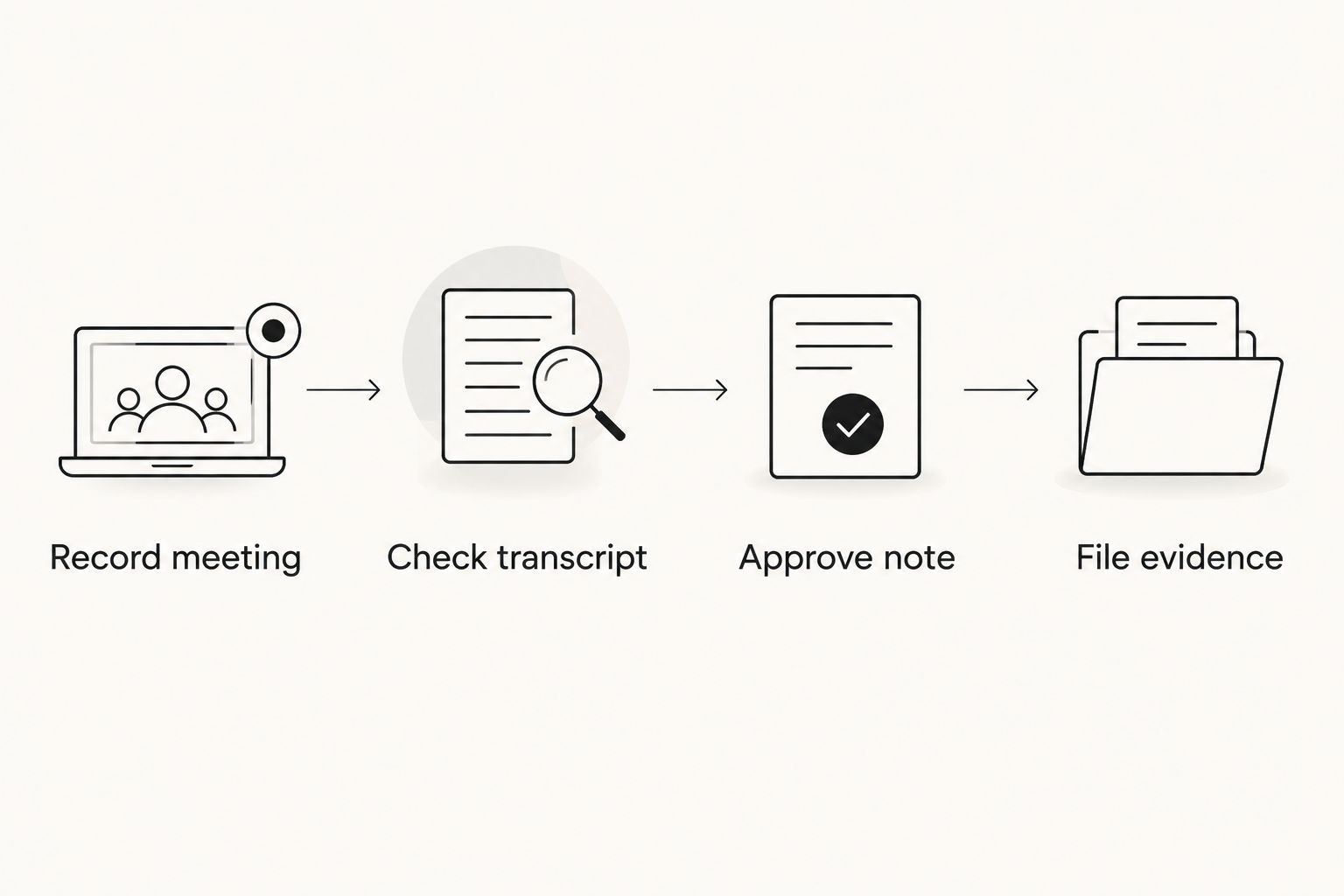
Use this sequence for personal-advice meetings in 2026:
- Record meeting. Confirm that recording is permitted for the meeting and that the client has received the information your recording procedure requires. Identify the meeting, participants and client record before transcription starts.
- Check transcript. Review names, figures discussed, client instructions, objections and statements about risk. Mark unclear passages for confirmation rather than turning uncertain speech into a firm assertion.
- Approve note. Have the responsible adviser check the file note against the conversation and distinguish facts provided by the client from the adviser's assessment, recommendations and agreed actions.
- File evidence. Put the approved note and relevant supporting material in the designated client record. Check that the CRM entry points to the right meeting and that the firm can retrieve the record under its retention policy.
The approval step changes the status of the output. Before review, it is a draft generated from a recording. After review, it is a record the adviser has checked against the meeting; the firm still needs its usual advice and compliance checks.
| Record | What it establishes | What it does not establish on its own |
|---|---|---|
| Recording or transcript | What was captured during the meeting, subject to recording quality and transcription errors | Why an adviser reached a conclusion or whether every required step occurred |
| Reviewed file note | The adviser's checked account of relevant facts, decisions and actions | That underlying advice was appropriate without the rest of the advice file |
| CRM entry | Where the meeting sits in the client workflow and who owns the next action | That the underlying note was checked or that every linked document is accurate |
| Supporting advice records | The material available to substantiate the advice process | That records are complete unless the firm checks them against its requirements |
The records do different jobs. Keep the transcript as supporting material when policy requires it, but do not ask it to serve as a substitute for a checked note, advice documents or evidence of review. Equally, do not delete it simply because a summary exists; apply the firm's approved retention schedule to each record type.
What must an adviser check before approving a meeting note?
Start with the claims that affect the advice. A transcript can turn a conditional statement into a firm instruction, or attach a concern to the wrong person when speakers overlap. The review should focus on whether the note preserves the client's circumstances, objectives, questions and instructions without supplying details the client never gave.
Check these parts against the recording or another reliable source where necessary:
- Client facts: names, stated circumstances and changes since the previous advice record.
- Objectives and concerns: what the client wants to achieve, what they rejected and what remains unresolved.
- Advice rationale: the distinction between information discussed, the adviser's assessment and any recommendation actually made.
- Warnings and limitations: gaps in information, risks raised and any point that needs follow-up before advice is finalised.
- Agreed actions: who will do what, and whether an action was proposed or accepted.
- Record identity: the correct client, meeting and adviser before the note reaches the CRM.
A file note should not claim that a disclosure occurred merely because the firm's template includes a disclosure field. It should reflect what the evidence supports. If the recording is unclear, record the uncertainty and resolve it through the firm's normal process; a confident sentence is not a correction.
For 2026 workflows, keep draft and approved states distinct. The firm should be able to tell which version the adviser reviewed and which version became part of the client record. That is a process requirement to test when assessing software, not a feature to assume every transcription platform provides.
How long must the evidence remain accessible?
ASIC's guidance on personal advice recordkeeping requires Australian financial services licensees to keep records demonstrating compliance with key personal-advice obligations for at least 7 years. That does not mean every draft transcript has the same retention status. The licensee needs to decide which records demonstrate compliance, document that decision and ensure the required records remain retrievable.
Test retrieval, not just storage. Ask someone who did not attend the meeting to locate the approved note, the supporting advice material and the evidence of any subsequent change. If the CRM shows a summary but the source material cannot be found, the firm cannot rely on the summary to answer every question about the original conversation.
Deletion also needs a rule. Keeping every audio file indefinitely is not automatically safer: the firm must weigh recordkeeping duties against its privacy and security obligations. Define which meeting artefacts are retained, who can access them and how the firm applies its retention schedule when a client record is closed or moved.
Why compliance outcomes vary between firms
The same transcription output can be usable in one advice workflow and insufficient in another. These factors determine whether the resulting record is dependable:
- Meeting type. A general information meeting and a personal-advice meeting create different questions about what the firm must document. Identify the meeting's purpose before choosing a note template.
- Recording conditions. Consent and other recording requirements depend on the circumstances and applicable state or territory rules. Check the firm's procedure before recording, not after a transcript appears.
- Review ownership. An adviser needs a defined point at which a draft note is checked and approved. An automatically populated CRM field is not evidence that someone reviewed its contents.
- CRM mapping. The client, meeting and task must match the right record. A correct transcript attached to the wrong client is a serious file-integrity problem.
- Privacy settings. Access, permitted use, security and cross-border disclosure need assessment where the Australian Privacy Principles apply. The existence of 13 Australian Privacy Principles does not make a vendor's settings compliant by default.
- Retention and retrieval. The firm must keep the records its obligations require and be able to produce them. A searchable note helps staff work, but searchability does not prove completeness.
Alcova provides an AI platform for wealth management firms that includes meeting transcription, notes, CRM sync, document generation and compliance records. Alcova is best for advice firms seeking those functions in one workflow, not for firms expecting software to approve advice on an adviser's behalf. Before adoption, check its recording, review, access and retention arrangements against your licensee's requirements; the platform description alone does not establish how each control is configured.
Can an adviser use a transcript instead of a file note?
No: a transcript is not a substitute for a reviewed file note. It records captured speech, while the note should identify material client facts, advice decisions and actions in a form the adviser has checked. Keep the transcript as supporting evidence when the firm's policy calls for it.
Does syncing a meeting summary to a CRM make it compliant?
No: CRM sync moves information; it does not verify it. Check the summary before filing, confirm that it attaches to the correct client and retain the supporting records required by the firm's procedure. A successful sync only establishes that data reached a destination.
Who is responsible when transcription gets a client detail wrong?
The advice firm remains responsible for its records and advice process. The responsible adviser should correct the material detail before approving the note, while the firm should preserve the record of its review in line with policy. A vendor's generated text does not transfer that responsibility.
FAQ
Can AI transcription meet compliance standards for advisers in Australia?
Yes, when the firm checks the output, records the advice rationale and keeps required evidence accessible. A transcript alone does not prove that the advice process met its obligations.
Is a transcript enough for a financial advice client file?
No. A transcript captures the conversation but does not replace a reviewed file note or the supporting records needed to show how advice was developed.
Does an adviser need to review AI-generated meeting notes?
Yes. The adviser should check material facts, client instructions, advice statements and actions before the note becomes an approved record.
Can an AI meeting assistant send notes straight to a CRM?
CRM sync can move notes, but the firm still needs a review and filing process. Check the note and the client record it will enter before treating the entry as final.
How long should an advice firm keep meeting records?
ASIC's personal-advice recordkeeping guidance requires licensees to keep records demonstrating compliance with key obligations for at least 7 years. The firm must determine which meeting artefacts form part of those required records.
Do Australian privacy rules apply to adviser meeting recordings?
Privacy obligations apply where the firm is covered by the Privacy Act and handles personal information in recordings or transcripts. Assess collection, use, disclosure, security and any cross-border disclosure before deployment.
What happens if a transcription provider has a data breach?
The firm needs to assess the incident against its own obligations, including the Notifiable Data Breaches scheme where applicable. Covered entities must take reasonable steps to complete an assessment of a suspected eligible data breach within 30 days.
One last thing
The most useful compliance test in 2026 is a retrieval exercise. Pick a completed meeting and ask a reviewer to identify the approved note, the evidence behind a material client instruction and the person who checked the record. If the reviewer cannot follow that path, improving transcription accuracy alone will not close the gap. Alcova's transcription and recordkeeping functions should be assessed against that same test.