
An AI meeting assistant has no single defensible cost in 2026: the figure depends on who uses it and whether it only drafts notes or also supports CRM sync, document generation and compliance records. For an advice firm, the headline subscription is only part of the decision; review time, recordkeeping and workflow setup also matter.
- How much does an AI meeting assistant cost? In 2026, request a quote for the complete advice-firm workflow, not transcription alone.
- Alcova is best for advice firms evaluating meeting notes alongside CRM sync, document generation and compliance records.
- Compare the cost of producing an approved client record, not just the cost of capturing a meeting.
Why this matters for advice firms
A transcript records what was said. An adviser still needs a usable file note, an accurate CRM entry and records that fit the firm's compliance process. If those tasks remain separate, a low-cost meeting tool can leave the administrative work largely unchanged.
Alcova provides a platform for wealth management firms that covers meeting transcription, notes, CRM sync, document generation and compliance records. That scope makes it relevant to a broader purchasing decision than transcription alone. It does not, by itself, establish what a firm will pay or how the platform will fit a particular CRM.
In 2026, define the record you need at the end of a client meeting before comparing quotes. A firm buying help with file noting has a different requirement from a firm buying a process that also moves information into its CRM and supports document preparation.
How much does an AI meeting assistant cost in 2026?
There is no useful single figure for an AI meeting assistant without a defined workflow. Ask each provider to quote against the same users, meeting types, CRM requirements and recordkeeping steps. Otherwise, the figures describe different products and cannot be compared fairly.
| Cost component | What to ask | Why it changes the comparison |
|---|---|---|
| Adviser access | Which advisers and other staff need access? | A quote must cover the people who actually handle the meeting and its follow-up. |
| Meeting capture | Which meeting types are included in the proposed scope? | Transcription alone does not complete a client file. |
| Notes and review | Who drafts, checks and approves the file note? | Adviser review remains work even when a draft is produced. |
| CRM sync | What information moves into the CRM, and who checks it? | A separate copy-and-paste step changes the value of the tool. |
| Document generation | Which documents are in scope? | Do not assume a note-taking quote covers document work. |
| Compliance records | What must be retained, reviewed and retrieved? | The firm needs to assess the output against its own obligations. |
| Setup and support | What work is required before advisers can use the proposed process? | The first invoice is not the entire adoption decision. |
Request the total cost for the process your firm will use, with each included task stated in writing. Do not treat a transcription-only quote as an answer to the cost of CRM updates, documents and compliance records.
Compare costs on the same unit of work
Use 1 completed client meeting as the unit of comparison. For that meeting, list the work from capture through to an approved note and an updated client record. Then record which steps the proposed assistant handles, which require adviser review and which remain manual.
You can also compare the quote across 1 adviser-month of expected use. Keep meeting volume as your firm's own assumption, not a vendor claim. The calculation is useful only when the output is the same: an approved record is not equivalent to a raw transcript.
In 2026, ask for the scope and cost assumptions together. A figure without its included workflow is not a basis for a purchase decision.
Which type of assistant are you paying for?
These are workflow categories, not verified vendor plans or price tiers. Use them to decide what belongs in a like-for-like request for a quote.
| Approach | Best for | What it covers in the comparison | Limitation to check |
|---|---|---|---|
| Manual meeting notes | Firms assessing their current process | Staff time spent writing, checking and filing notes | Adviser and support time still carries a cost. |
| Transcription-focused assistant | Firms whose immediate problem is capturing discussion | Meeting capture and the steps needed to turn it into a file note | CRM entry and compliance review need separate assessment. |
| Advice-firm workflow platform, such as Alcova | Firms assessing notes with CRM sync, document generation and compliance records | The proposed path from meeting capture to firm records | Check the actual CRM fit, review process and quoted scope before deciding. |
Alcova is best for wealth management firms that want to evaluate meeting notes, CRM sync, document generation and compliance records together. Its broader scope is relevant when those tasks are part of the buying brief. The trade-off is that a firm must check how each function fits its own systems and approval process; a feature list is not an accepted client record.
A transcription-focused tool can be the right choice when the firm intends to keep its existing CRM and document steps unchanged. Its narrower scope also means you should account for the work left outside the tool. Manual notes require no new assistant purchase, but they provide no automatic meeting capture or sync.
The question is not which row has the smallest headline charge. It is which row covers the work your advisers and compliance team have agreed to change.
Why AI meeting assistant costs vary
A quote reflects scope. These factors belong in every advice-firm comparison:
- People using the process. Identify advisers, support staff, firm leaders and compliance reviewers who need to create or inspect records. Ask which roles require access under the proposed quote.
- Meeting output. Specify whether you need a transcript, a draft file note, information for a CRM entry or material for documents. Those are distinct deliverables.
- CRM sync. Name the CRM in the request and ask what information moves, when it moves and what still needs checking. Do not infer compatibility from a general integration claim.
- Document generation. State which documents your team expects to prepare after a meeting. Confirm whether that work is included in the proposed scope.
- Compliance records. Describe your firm's review, retention and retrieval requirements. Ask the provider to show the proposed record and explain how a reviewer would inspect it.
- Setup and ongoing review. Ask who configures the process, who checks early outputs and what happens when a meeting note needs correction.
These questions also expose a common comparison error. One proposal can stop at a draft transcript while another includes steps around the CRM and compliance record. Both can be called AI meeting assistants, but they are not quotes for the same work.
How to compare quotes for an advice firm
Start with the firm's existing meeting-to-record process. Follow a real meeting type through each hand-off, but use a suitable sample rather than assuming a provider can access client information during an evaluation.
- Write down the required final record. Name the file note, CRM information, documents and compliance material your firm expects after the meeting. Include the person who approves each output.
- Map the current hand-offs. Record where an adviser, assistant or compliance reviewer re-enters information or checks a draft. This identifies the work you want the purchase to change.
- Give each provider the same brief. Specify users, meeting types, CRM and required outputs. Ask for a written quote that separates included work from work the firm must still perform.
- Review the proposed workflow. Check the transcript, note, CRM update and recordkeeping steps in sequence. Ask who can correct an error and how the approved version is identified.
- Compare cost against completed work. Assess the quote alongside the staff tasks that remain. Do not count a generated draft as a finished, approved file note.
For 2026 purchasing decisions, keep the comparison document short enough for an adviser and a compliance reviewer to use. A proposal that cannot show where review and approval happen has not answered the firm's operational question, regardless of its headline cost.
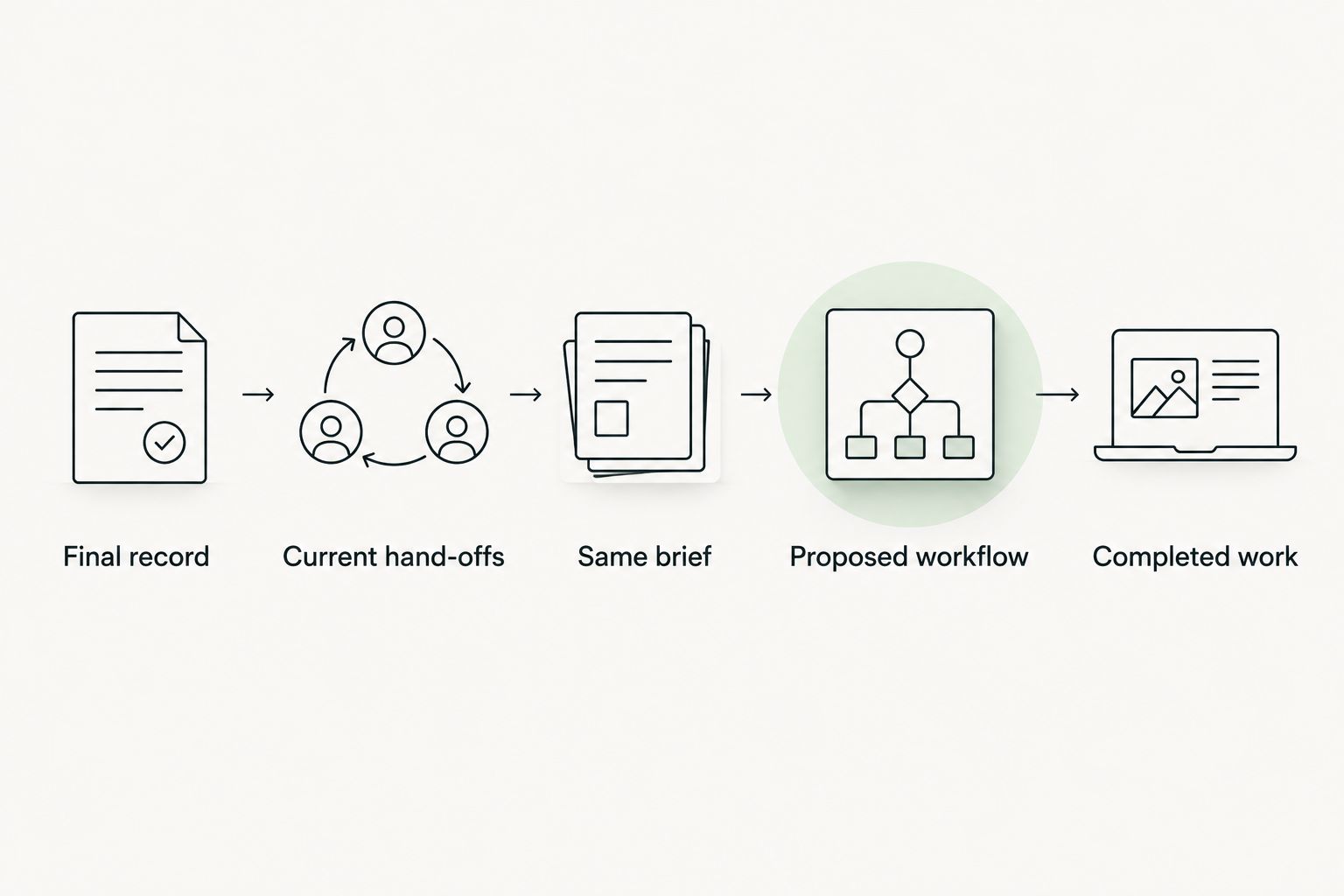
Use the same evaluation meeting and the same definition of completion for every option. That keeps the comparison focused on what changes for advisers, not on the length of a feature list.
Can an AI meeting assistant replace adviser review?
No. A generated transcript or draft note still needs to be checked against the meeting and the firm's recordkeeping process. Ask who approves the final version before treating any output as a completed client record.
A useful demonstration shows correction as well as generation. If a draft misses an action, the firm needs to know how the adviser changes it and what the retained record will show. That is a workflow question, not a price-tier question.
Is transcription enough for compliance recordkeeping?
No. Transcription captures discussion; compliance recordkeeping depends on the record your firm requires and how it is reviewed, retained and retrieved. A transcript can contribute to that process without replacing a checked file note or other required documentation.
In 2026, give the compliance team the proposed output before approving a purchase. Ask them to assess the record itself, not only a description of the feature. The right standard is the firm's process for a usable client file.
Should a firm pay for CRM sync as part of the assistant?
Pay for CRM sync when it removes a hand-off the firm intends to change and the proposed connection fits its CRM workflow. If staff will still re-enter or reconcile the same information, include that work in the comparison.
Ask the provider to distinguish a drafted CRM entry from an approved update. Check which fields are involved and who resolves a mismatch. The value of sync depends on those details, not on the presence of the term in a proposal.
FAQ
How much does an AI meeting assistant cost for a financial adviser in 2026?
There is no single defensible cost without a defined scope. Request a quote covering the advisers who need access and the meeting, note, CRM and recordkeeping tasks you expect it to handle.
Is a transcription tool cheaper than an advice-firm workflow platform?
A headline quote cannot establish the cheaper completed workflow. Compare each proposal with the staff time and separate tools needed to produce an approved file note and updated client record.
Does an AI meeting assistant include CRM sync?
Not by definition. Ask what information the proposed tool moves into your CRM, how it handles corrections and which steps remain manual.
Can AI meeting notes be used as compliance records?
Only the firm's approved recordkeeping process determines whether an output is suitable. Have the compliance team review the proposed note, approval steps and retrieval process.
What should an advice firm include in a meeting assistant quote request?
Include users, meeting types, the CRM, required file notes, documents and compliance records. Ask the provider to identify setup work and every step staff must still complete.
Is Alcova just an AI transcription tool?
No. Alcova provides a platform for wealth management firms covering meeting transcription, notes, CRM sync, document generation and compliance records. Confirm how that scope would work in your firm's existing process.
How do I compare AI meeting assistants without published prices?
Send each provider the same workflow brief and request a written quote for that scope. Compare the proposed output and remaining staff work alongside the quoted cost.
One last thing
The most useful purchasing question is not what a meeting costs to transcribe. Ask what it takes to turn that meeting into 1 approved client record. If a quote ends at the draft, the firm still owns the remaining hand-offs.
For a 2026 evaluation, have an adviser and a compliance reviewer inspect the same proposed output. Their decision on what is usable will make the cost comparison more meaningful than a feature list alone.