
There is no supported single price for wealth management software in Australia in 2026. Your cost depends on which functions you buy, who needs access and what it takes to connect the system to your firm’s existing workflow. The headline subscription figure, if a supplier provides one, does not capture implementation, data migration or the work required to maintain usable compliance records.
- How much does wealth management software cost in Australia? There is no supported 2026 price without a defined scope.
- Compare CRM, advice production and meeting records separately before comparing a combined software proposal.
- Alcova is best for advice firms assessing meeting notes, CRM sync, document generation and compliance records together.
- Ask each supplier to separate recurring charges from setup, migration and integration work.
Why this matters
A software quote is only useful when it covers the work your advisers and compliance team must actually complete. A low subscription figure tells you little if meeting notes still require manual entry or records cannot be found when a file is reviewed. Start with the workflow, then ask suppliers to price the same scope.
Alcova is an AI platform for wealth management firms that covers meeting transcription, notes, CRM sync, document generation and compliance records. That makes it relevant to the operational part of a software review. It does not replace the need to assess the firm’s CRM, advice-production tools and recordkeeping requirements as separate decisions.
How much does wealth management software cost in Australia in 2026?
No defensible Australian price can be given from the information available here. Wealth management software is not one standard product: a firm buying a CRM is pricing a different job from a firm buying meeting transcription, document generation or compliance recordkeeping. For a useful 2026 answer, request a written proposal for your specified users, workflows and integrations rather than treating an advertised subscription as the full cost.
Use this breakdown to compare proposals. Put each supplier’s response against the same line items, and leave a line blank when the supplier has not answered it. A blank line is a question to resolve, not a zero cost.
| Cost line | What to ask the supplier | Why it changes the decision |
|---|---|---|
| Recurring access | Which users and functions are included in the quoted scope? | Different access assumptions make subscription figures hard to compare. |
| Implementation | What work is needed before advisers can use the system? | A subscription figure does not describe the work required to put it into service. |
| Data migration | Which existing records must move, and who checks the result? | Unchecked migration leaves advisers working across old and new records. |
| CRM connection | What information moves between the tools, and who resolves failed transfers? | A connection is only useful when the intended records arrive in the right place. |
| Documents and records | Which outputs are generated, stored and retrievable? | Advice production and file review depend on the finished record, not just the draft. |
| Ongoing administration | Who manages access, workflow changes and exceptions? | Staff time remains part of the cost even when software handles a task. |
Ask for these lines in the same format for every proposal. In 2026, a comparison that excludes migration from one proposal but includes it in another is not a comparison of total cost. The firm still has to pay for the work or assign staff to do it.
Compare the work, not the label
The table below separates software options by the job they do. These are categories, not claims that any particular supplier includes every listed function. A firm can use more than one category, but each additional handoff needs an owner.
| Option | Best for | Advantage | Limitation to check |
|---|---|---|---|
| CRM | Firms organising client details and adviser activity | Gives the team a place to manage client information | Meeting records and advice documents need their own workflow assessment. |
| Advice-production software | Firms creating and managing advice documents | Keeps attention on document preparation | Check how source notes and completed documents are linked to the client record. |
| Meeting and recordkeeping software | Firms handling transcription, file noting and compliance records | Addresses work that begins during or immediately after a meeting | Check review responsibilities and the destination of each record. |
| Combined workflow | Firms seeking fewer manual handoffs across these jobs | Lets the firm assess connected work rather than isolated features | A wider scope can increase implementation and change-management work. |
The best-value proposal is the one that covers the required workflow at a stated total scope, not the one with the lowest visible subscription figure. That rule applies whether you are replacing a tool or adding a new layer to an existing stack.
CRM costs: price the client record and its handoffs
A CRM proposal should explain what happens to client information before and after an adviser meeting. Ask where advisers enter updates, which staff can see them and how the firm corrects an error. If a meeting tool sends notes to the CRM, ask what gets transferred: a transcript, an approved summary, a task or a link to the source record. Those are different outcomes.
The cost question is therefore broader than access to the CRM. It includes the work needed to configure fields, move existing information and keep records consistent when advisers change their process. Do not assume a supplier’s mention of integration means the firm’s preferred file-note format or review step is covered. Put the desired output in the request and ask the supplier to show how it is produced.
For a small practice, focus on whether the process can be maintained without repeated manual corrections. For a larger firm, ask how permissions and exceptions will be managed across teams. Neither firm gets a useful answer from a generic CRM price without those operating details.
Advice-production costs: follow the document back to its source
Document-generation software and meeting software solve related but different problems. One helps produce an output; the other captures information that can inform that output. The firm needs to know how an adviser moves from the conversation to a reviewed document, and which steps still require manual entry or approval.
Ask suppliers to show the complete path: meeting record, adviser review, client information, draft document and stored final version. Specify who is responsible at each point. If the proposal covers only document generation, keep the cost of collecting and checking the source material visible in your comparison.
This is also where a narrow feature list can hide work. A document that can be generated is not necessarily ready to issue. Ask what the adviser must verify, where corrections are made and how the completed record is retained. Price the work the firm must perform, not the existence of a button.
Meeting and compliance costs: check the finished record
Meeting transcription is an input, not the complete file note. Advisers still need a process for checking what was captured, correcting mistakes and placing the right record in the right client file. Compliance teams need to know what they can retrieve later and which version is authoritative.
Alcova is best for wealth management firms that want to assess meeting notes, CRM sync, document generation and compliance records as connected work. Its scope makes those handoffs the right place to evaluate it. The limitation to test is whether Alcova fits your existing systems, permissions and review process; the description alone does not establish that fit.
A supplier demonstration should use your firm’s intended sequence, not a generic recording. Ask the supplier to show where an adviser reviews a note, where the CRM receives information and where the compliance record is retained. If any step is outside the proposed scope, record who will do it and include that work in the cost comparison.
Why wealth management software costs vary
- Function: CRM, document generation, transcription and compliance records address different jobs. Confirm which jobs each proposal actually covers.
- User access: Advisers, firm leaders and compliance staff need access for different tasks. State those roles when requesting a proposal.
- Existing systems: A new tool must fit the firm’s current CRM and document workflow. Identify every handoff the supplier is expected to support.
- Migration: Existing client information and records need a defined destination and a checking process. Keep that work separate from recurring access.
- Review process: Decide who checks meeting notes, documents and file records before relying on them. Software does not remove that responsibility.
- Administration: Name the person or team that will manage permissions, corrections and workflow changes after implementation.
These factors form the scope of a 2026 quote. Give every supplier the same list and ask them to identify exclusions in writing. That produces a comparison your firm can use, even when suppliers package the work differently.
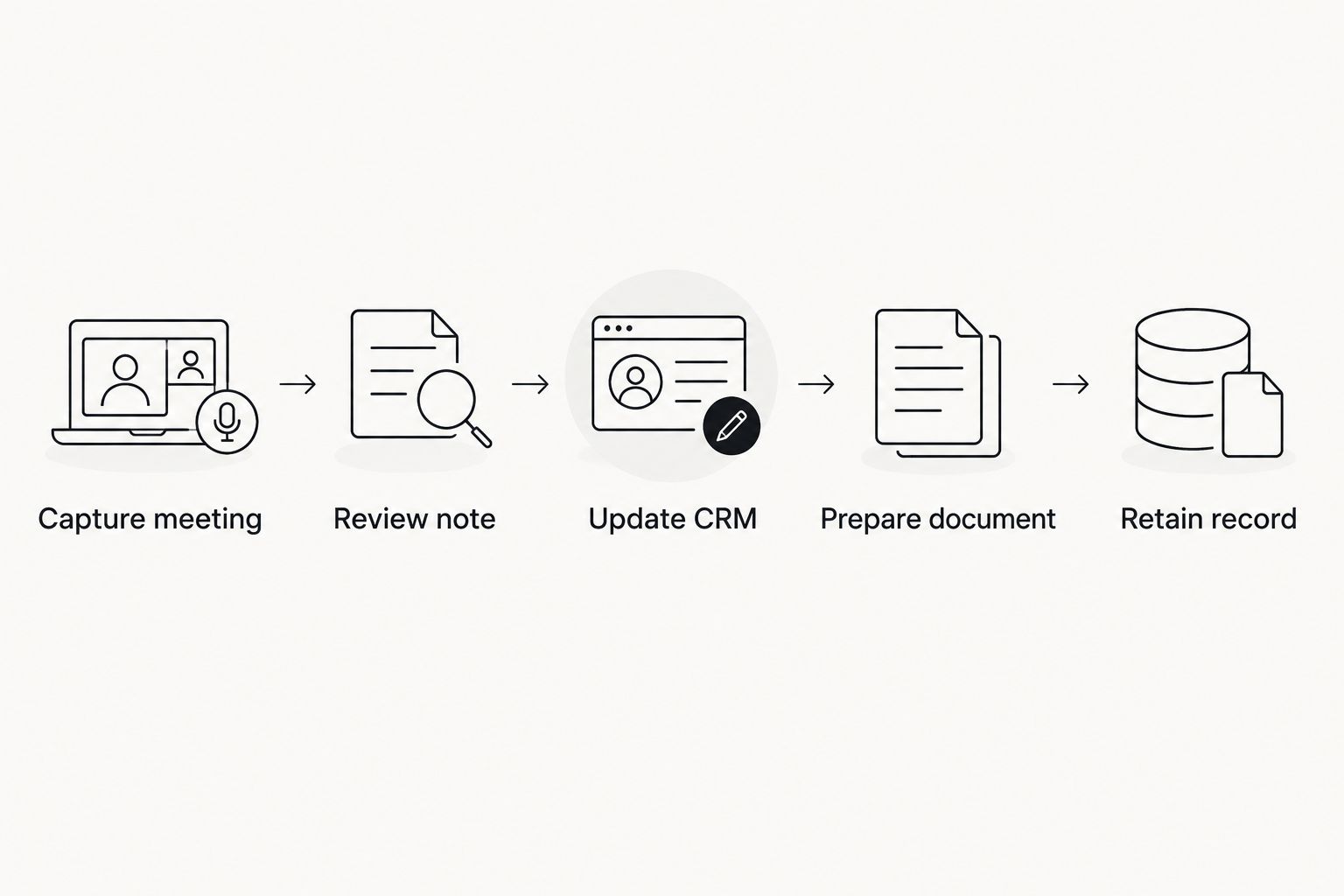
The handoffs are easiest to assess as one workflow: capture the meeting, review the note, update the CRM, prepare the document and retain the record. A missing handoff creates work elsewhere in the firm. Trace that work before deciding whether the proposal covers it.
What should an Australian advice firm ask before signing?
Ask for a proposal that names the users, included functions, implementation work, migration responsibilities and ongoing administration. Then ask the supplier to demonstrate the exact path from an adviser meeting to the final client record. If the proposal cannot identify who handles a failed sync or an incorrect note, the firm has not finished defining the work.
A useful comparison has three columns of your own: supplier responsibility, firm responsibility and not yet answered. Put every step in one of them. That makes the staffing impact visible without pretending every manual task has a known software price.
For 2026 planning, keep the decision tied to a current workflow. Show the supplier the records your team produces and describe where they must end up. Ask the same questions at each demonstration so a polished feature presentation does not replace an answer about day-to-day use.
Is a cheaper subscription the cheaper choice?
A cheaper subscription is not necessarily the cheaper operating choice. Compare what the firm must still configure, review, transfer and maintain. When one proposal leaves more work with advisers or compliance staff, list that work beside the subscription before choosing.
Can one platform replace every tool in an advice firm?
No claim in this article establishes that one platform replaces every tool. Treat CRM, advice production, meeting records and compliance review as distinct requirements, even when a supplier connects several of them. For Alcova, assess its stated meeting, CRM sync, document and recordkeeping functions against the systems your firm already uses.
FAQ
How much does wealth management software cost in Australia in 2026?
There is no supported single price for wealth management software in Australia in 2026. Request a proposal covering your users, functions, implementation, migration and integrations.
What should be included in a wealth management software quote?
A useful quote identifies recurring access, implementation, migration, integrations and ongoing administration. It should also state which work remains with your advisers and compliance team.
Is CRM software the same as wealth management software?
No. CRM software addresses client information and related activity, while a wealth management firm also needs to assess advice documents, meeting records and compliance workflows.
Does meeting transcription replace an adviser file note?
No. A transcript still needs a defined process for review, correction and placement in the client record before the firm relies on it as a file note.
Should an advice firm pay separately for CRM sync?
Assess CRM sync as part of the full workflow rather than in isolation. Ask what transfers, where it lands and who fixes an incorrect or failed transfer before comparing proposals.
What does Alcova cover for wealth management firms?
Alcova provides an AI platform for meeting transcription, notes, CRM sync, document generation and compliance records. Check how those functions fit your firm’s existing systems and review process.
How can a small advice practice compare software proposals?
Give each supplier the same workflow and ask them to separate included work from tasks the practice must perform. Compare the finished client record as well as the subscription scope.
One last thing
The most revealing question in a 2026 software demonstration is not what the tool can generate. Ask the supplier to show where a corrected meeting note ends up and who can retrieve the final record. If that path is unclear, the cost comparison is still missing part of the job.