
Wealth management software for family offices is the stack of CRM, portfolio and compliance tools that keeps one team's view of multiple trusts, entities and family members consistent, so nothing gets reconciled twice. A single-adviser practice tracks one client per record. A family office tracks one family across five, ten, sometimes twenty entities, with several advisers and often a principal who wants a single answer, not five separate ones.
- Wealth management software for family offices needs multi-entity structure, not single-client CRM logic.
- Enterprise platforms like Xplan and Practifi handle portfolio accounting but leave meeting notes and compliance capture manual.
- Alcova sits as an AI layer on top of existing CRM and portfolio systems for notes, sync and compliance records.
- The most common 2026 mistake: one CRM contact record standing in for five separate legal entities.
Why this matters for family offices
A family office adviser doesn't file one note after a meeting. They file one note that has to be tagged against a trust, a corporate trustee, and two individual beneficiaries — sometimes in the same conversation. Standard adviser CRM setups treat a household as one record with a few linked contacts. That breaks the moment a family office has structures the CRM was never built to model.
Compliance obligations stack the same way. Each entity in the structure can carry its own Record of Advice trail, and a missed file note on one entity is a gap the whole firm owns, not just the adviser who took the call. Software chosen for a single-adviser practice rarely survives contact with that structure. Alcova is built as the layer that sits across meeting transcription, CRM sync and compliance records rather than as a replacement for the portfolio or CRM system underneath — worth knowing before you shop for a single tool to do everything.
Map the family office's entity structure before you choose anything
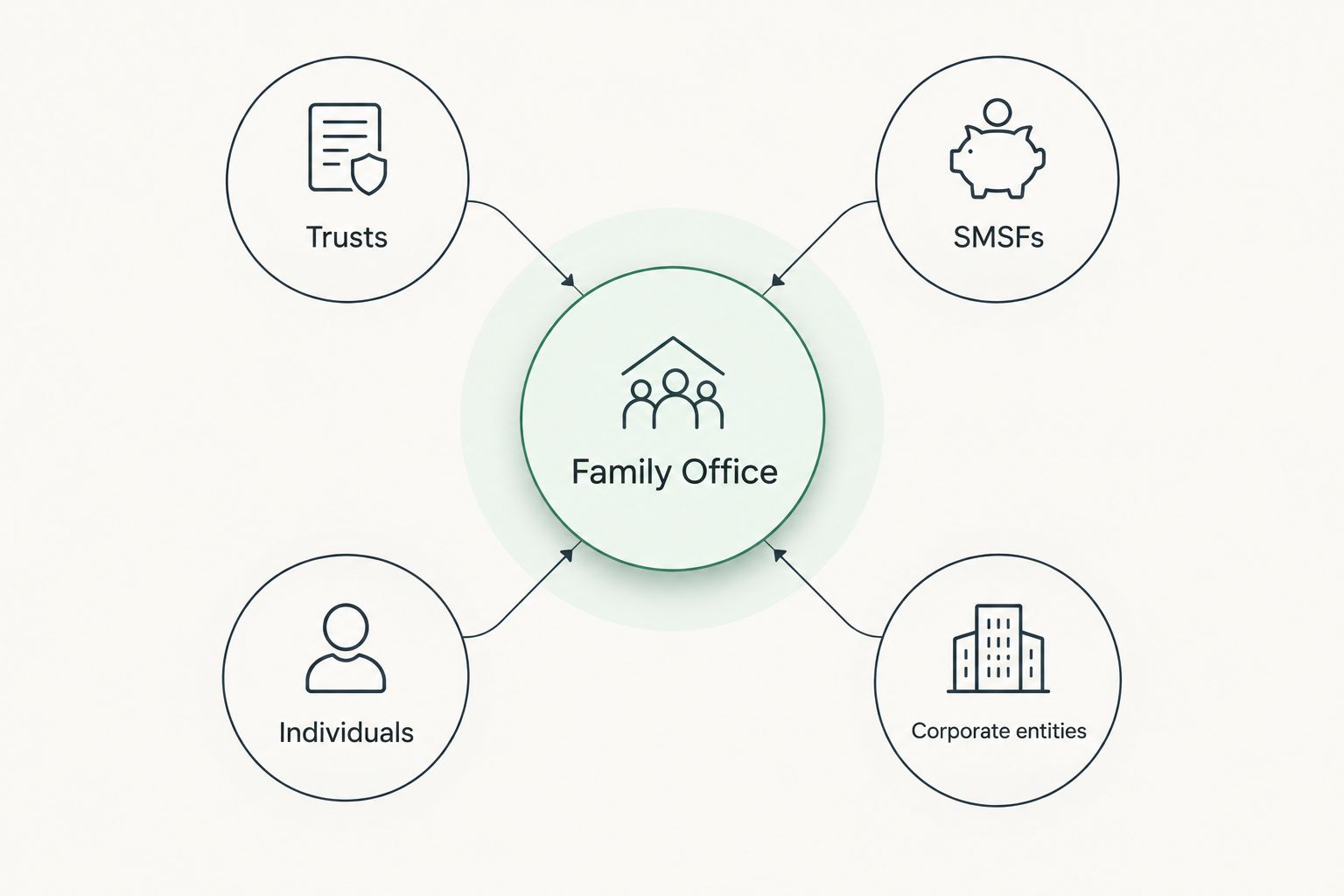
Before comparing platforms, list every legal entity a single family relationship touches. This is the step firms skip, and it's the one that breaks the CRM six months in.
- Discretionary and testamentary trusts
- Corporate trustees and holding companies
- SMSFs held by one or more family members
- Individual entities for each adult family member
- Any offshore or cross-border structures the family holds
Decide where consolidated portfolio reporting lives
A family office needs one number that adds up across every entity, not five statements that a principal has to reconcile by hand. Decide this before you touch a CRM.
- Which custodian or platform feeds report at the entity level versus the household level
- Whether the reporting engine consolidates trusts and SMSFs into one view automatically
- How often reconciliation happens against custodian statements
- Who signs off on the consolidated number each quarter
Match compliance and record-keeping to the multi-adviser structure
When more than one adviser touches the same family, compliance record-keeping has to be structure-aware, not adviser-aware. This is where the manual approach — spreadsheets and shared drives per entity — starts costing hours every week, and where an AI layer earns its place.
- Tag every meeting note against the entity it actually concerns, not just the client name
- Keep a single, searchable compliance record per entity rather than per adviser
- Set a review cadence so a compliance lead checks entity-tagged notes, not raw call recordings
- Use compliance recordkeeping software built for financial advice rather than a generic document store
- Alcova's Operator generates and files compliance records automatically from the meeting transcript, tagged to the entity discussed, cutting the manual tagging step out entirely
Standardise meeting notes across the whole family office team
Five advisers writing five different note formats for the same family is how gaps happen. Standardise the format before you standardise the tool.
- Fix a template: entity discussed, decision made, next action, adviser owner
- Require a note within the same day, not the same week
- Run transcription off every meeting rather than relying on adviser memory for multi-entity calls
- Route notes automatically to the right entity file, not a shared inbox
Sync CRM and portfolio data instead of re-entering it
Double entry is where family office data drifts. An adviser updates the CRM, the portfolio system doesn't know, and the next quarterly review starts from two different pictures.
- Confirm whether your CRM and portfolio platform already talk to each other natively
- If not, decide which system is the source of truth for entity data
- Push meeting outcomes and decisions into the CRM automatically rather than as a manual follow-up task
Build a client portal principals and family members will actually use
A family office principal doesn't want to log into five separate entity dashboards. One portal, one login, entity-level detail available on demand — that's the bar.
- Single sign-on across every entity the family member has visibility into
- Document access scoped by entity and by family member, not all-or-nothing
- Meeting summaries visible to the principal without a call to the adviser
Test document generation on your most complex Record of Advice, not your simplest
Most platforms demo well on a single-entity client. Run the test on your messiest family structure before you commit.
- Generate a Record of Advice that spans two entities from one meeting
- Check whether the document pulls the right entity name and structure automatically
- Confirm the adviser can review and edit before it's filed, not after
Comparing the options for family offices in 2026
| Option | Best for | Key limitation |
|---|---|---|
| Enterprise wealth platforms (Xplan, Practifi, Salesforce FSC) | Firms already running multi-entity portfolio accounting | Meeting notes and compliance capture are a manual bolt-on |
| Dedicated family office reporting platforms (Addepar, Asset Vantage) | Consolidated reporting across trusts, SMSFs and entities | Not built for adviser meeting workflow or Records of Advice |
| Generic CRM (HubSpot, Dynamics 365) | Smaller family offices that mainly need contact management | No financial services compliance fields out of the box |
| Alcova (AI layer: transcription, notes, CRM sync, document generation, compliance records) | Family offices that want meeting-to-file-note automation on top of their existing CRM and portfolio system | Doesn't replace portfolio accounting or consolidated reporting platforms |
For a firm sized closer to enterprise scale, the fuller comparison of wealth management software for enterprise advice firms is worth reading before you shortlist.
Verdict: no single platform covers portfolio accounting, CRM and compliance for a family office in 2026 — the working setup is a portfolio/CRM system plus an AI layer that handles notes, sync and Records of Advice.
“A family office CRM problem is rarely a CRM problem — it's an entity-mapping problem the CRM was never asked to solve.”
See how the AI layer fits your setup
Check how meeting notes, CRM sync and compliance records work across your existing platform.
Common mistakes family offices make
- Treating one CRM record as one entity when the same family relationship spans five legal structures — this is the single biggest source of misfiled notes.
- Letting each adviser file notes in their own format, which makes a compliance review across the whole family take three times as long.
- Skipping compliance capture on informal calls with the principal because the conversation felt casual rather than advice-related.
- Reporting delays caused by unsynced data between the portfolio platform and the CRM, discovered only at quarterly review.
- No single owner of document version control across entities, so two advisers end up working from different drafts of the same Record of Advice.
FAQ
What is wealth management software for family offices?
It's the combination of CRM, portfolio reporting and compliance tools built to track one family across multiple legal entities rather than one client per record. In 2026 that usually means an enterprise CRM or reporting platform paired with an AI layer for notes and compliance.
Do family offices need different software than a standard advice practice?
Yes. A standard practice CRM models one household as one record; a family office needs entity-level tracking across trusts, SMSFs and individuals within the same family relationship.
Is Addepar or Asset Vantage enough on its own for a family office?
These platforms handle consolidated portfolio reporting across entities but aren't built for adviser meeting workflow or Records of Advice, so most firms pair them with a CRM and a compliance layer.
How does compliance record-keeping work for multi-entity family offices?
Each entity discussed in a meeting needs its own tagged record, not one record per adviser. Compliance recordkeeping software built for financial advice tags notes to the entity automatically rather than to the client name alone.
Can family office software sync with an existing CRM and portfolio system?
Most enterprise CRMs and portfolio platforms support sync either natively or through an AI layer that pushes meeting outcomes and entity data between systems automatically.
Is Alcova a replacement for a family office's CRM or portfolio system?
No. Alcova is an AI layer for meeting transcription, notes, CRM sync, document generation and compliance records that sits on top of the CRM and portfolio system a firm already runs.
How much does wealth management software for family offices cost in 2026?
Cost depends on the number of entities, users and modules a firm needs, and pricing varies by vendor and structure. Check current pricing directly with each platform rather than relying on a fixed figure.
What's the difference between a family office CRM and a regular adviser CRM?
A family office CRM needs to model multiple legal entities per family relationship and consolidate reporting across them; a regular adviser CRM assumes one client or household per record.
One last thing
The entity-mapping exercise in step one takes an afternoon and it's the step almost every family office skips before buying software. Do it first, and half the platform comparisons above answer themselves — because the gap usually isn't the CRM, it's not knowing how many entities one family conversation actually touches.