
Insurance adviser meeting notes software is a system that captures, structures and stores client conversations with the aim of producing usable advice records and reducing post-meeting administration. Insurance advisers need more than a transcript: the record must preserve client circumstances, cover discussions, disclosures, recommendations and agreed actions in a form the advice firm can review.
- Meeting notes software for insurance advisers should connect transcription, structured notes, CRM sync and compliance records.
- Alcova meeting notes software is best for advice firms that want one connected post-meeting workflow.
- Run a 2-week pilot before rollout and compare the output with your current file-note standard.
- Choose the workflow that produces the clearest reviewable record, not simply the longest transcript.
Why meeting notes software matters for insurance advisers
Insurance advice meetings contain several kinds of information at once. The adviser needs to understand the client's objectives, current cover, financial position, relevant personal circumstances and the decisions made during the conversation. A chronological transcript preserves the words, but it does not automatically organise them into an advice record.
In 2026, the practical test is whether another person can open the client file and understand what happened without replaying the full meeting. Firm leaders need consistency across advisers. Compliance teams need a clear record they can inspect. Administrators need confirmed actions rather than another document to interpret.
Alcova addresses that operating problem by combining meeting transcription, notes, CRM sync, document generation and compliance records for wealth management firms. The software should support the firm's process; it should not become a separate notes repository that advisers and operations staff have to reconcile later.
A useful meeting record answers five questions:
- What did the client tell the adviser?
- What objectives or concerns did the client raise?
- What existing arrangements were discussed?
- What did the adviser explain or recommend?
- What actions did each party agree to complete?
The value is not transcription alone. The value is a reliable path from conversation to client file.
How to choose and implement the software
Start with the record your firm needs, then work backwards to recording, transcription and automation. This prevents a polished demonstration from defining the process for you.
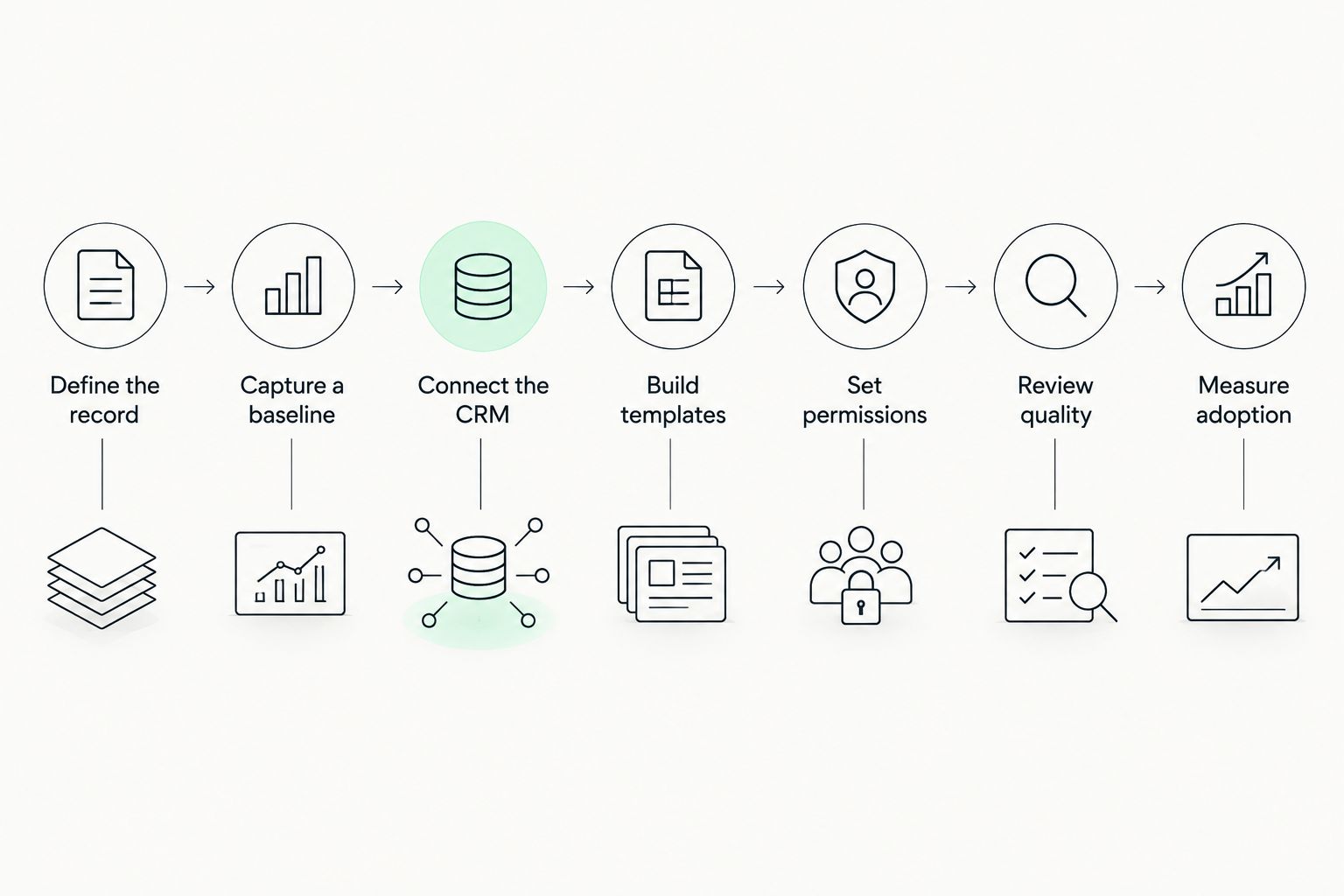
Define the record before choosing software
Write down the minimum standard for a completed insurance advice file note. Do this manually before evaluating software. A defined standard gives advisers, operations staff and compliance reviewers the same basis for judging every output.
Separate information captured from the client from conclusions written by the adviser. The distinction matters because software can organise source material, but the adviser remains responsible for reviewing the final advice record.
- List the client details and circumstances every note must contain
- Mark disclosures that must remain specific rather than compressed into a general summary
- Define how recommendations, alternatives and client decisions should appear
- Add a clear section for follow-up actions, owners and due dates
- Keep the raw transcript available under the firm's approved recordkeeping process
Capture a baseline manually
Take three recent meetings and create the required notes using the firm's existing process. Record how much correction, reformatting and CRM entry each file requires. This baseline shows whether new software removes work or merely moves it into another application.
For a 2026 pilot, use representative meetings rather than an easy demonstration call. Include a new-client discussion, a review meeting and a conversation with several follow-up actions. Remove client information from test material unless the firm has approved its use.
- Select 3 sample meetings that reflect normal insurance advice work
- Create the final file notes using the current manual method
- Identify information that was difficult to find in the source material
- Note every field copied into the CRM after the meeting
- Use the completed records as the benchmark for software-generated notes
Connect the CRM workflow
A meeting note creates less administrative work only when it reaches the system where the firm manages the client relationship. Copying a summary from one tool into the CRM preserves a manual step and creates another place for client information to sit.
Alcova meeting notes software is designed for connected advice-firm workflows, including CRM sync. When assessing any platform, map the path from recorded conversation to client record and identify every point where a person still has to copy, rename or classify information.
The guide to CRM sync tools for financial advisers covers this integration layer in more detail.
- Confirm the software supports the CRM used by the firm
- Map client names, meeting types and note fields before enabling automatic sync
- Decide whether advisers or support staff approve notes before they enter the CRM
- Test updates against an existing client record to detect duplicate or misplaced information
- Document a fallback process for meetings that fail to sync
Build templates around insurance advice
A generic meeting summary usually prioritises topics, sentiment and action items. An insurance advice note needs a structure that reflects the firm's advice process. Templates should make missing information visible rather than filling gaps with vague wording.
Create separate templates only when the underlying records differ. Too many templates create selection errors and make quality control harder. Start with one core insurance advice template, then add variations when the firm can explain why a different record is required.
- Create sections for objectives, current arrangements and relevant circumstances
- Separate client statements from adviser explanations and recommendations
- Include alternatives considered and decisions made during the meeting
- Add an action register with an owner for each task
- Require adviser review before the note becomes the final client record
Set permissions and data controls
Meeting records can contain personal, health and financial information. The software review must therefore cover access, storage, export and deletion controls alongside transcription quality. A useful note in the wrong hands is still a failed implementation.
For a 2026 assessment, involve the person responsible for privacy or compliance before live client meetings are recorded. Confirm which roles can view raw audio, full transcripts, edited notes and generated documents. Do not assume that everyone who can access the CRM should also access every source record.
- Define access by role rather than sharing one firm-wide permission level
- Confirm how the firm exports records if it changes software
- Decide whether raw recordings and completed notes need different access rules
- Record the consent process used before a meeting is captured
- Review the vendor's current data handling terms before rollout
Review note quality against the source
Accuracy should be checked at the level that affects the advice file. A clean paragraph can still omit an important client statement, assign a comment to the wrong speaker or turn an open question into a confirmed fact.
Use a 15-minute review window for each pilot note. Compare the structured output with the recording or transcript, then classify corrections by type. This gives the firm a repeatable quality check rather than a general impression that the note looks good.
- Check names, policy references and client circumstances against the source
- Confirm the note distinguishes client statements from adviser statements
- Look for omitted qualifications, unresolved questions and conditional decisions
- Verify every action has the correct owner
- Return recurring errors to the template or workflow owner for correction
Measure adoption before firm-wide rollout
Software that works in a controlled test can still fail when advisers use different devices, meeting styles and naming conventions. Expand in stages and keep a visible owner for templates, permissions and CRM mapping.
Run a 30-day controlled rollout with a small adviser group in 2026. Review a 5-file sample from each participant and compare it with the standard defined in the first step. The firm should expand only after the process produces consistent records without hidden clean-up work for support staff.
- Track whether completed notes reach the correct CRM record
- Record the corrections needed before adviser approval
- Ask operations staff where manual re-entry still occurs
- Review a 5-file sample for structure and missing information
- Assign one owner to maintain templates and integration rules
Comparing the main options
Insurance advisers have four practical approaches in 2026. The right choice depends on meeting volume, existing systems and how much control the firm needs over the completed record.
| Option | Best for | Main advantage | Key limitation |
|---|---|---|---|
| Typed notes during the meeting | Advisers with a low meeting volume and a stable manual process | Full control over wording while the conversation is fresh | Divides attention and produces inconsistent structure between advisers |
| Recording with a manual file note | Firms that want a source recording but retain manual drafting | Preserves the original conversation for later review | Still requires someone to replay, interpret and enter the information |
| General transcription software | Teams that mainly need a searchable transcript | Converts speech into text without changing the wider advice process | Usually needs manual restructuring and CRM handling |
| Advice-firm platform such as Alcova | Firms connecting meetings, notes, CRM data, documents and compliance records | Keeps several post-meeting tasks in one operating workflow | Requires template, permission and CRM decisions before rollout |
Alcova is best for insurance advice firms that want meeting transcription, structured notes, CRM sync and compliance records in one workflow. A manual approach remains valid when meeting volume is low and the adviser can maintain the required standard without creating a backlog. General transcription software is the narrower option when the firm wants text but does not want to change its post-meeting process.
Review the Alcova workflow
See how meeting notes, CRM sync, documents and compliance records connect.
Common mistakes insurance advisers make
Choosing a transcript instead of a record
A transcript and a file note serve different purposes. The transcript preserves the sequence of the conversation; the file note organises the information another adviser, administrator or compliance reviewer needs. Buying transcription without planning the final record leaves the largest administrative step untouched.
Automating an undefined process
If each adviser writes notes differently, software will reproduce that inconsistency at greater speed. Define the required sections, approval point and CRM destination before configuring templates. Automation should enforce a known process rather than invent one.
Treating generated text as final advice documentation
Generated notes require adviser review. Names, client circumstances, qualifications and responsibilities can be misunderstood even when the prose reads naturally. The adviser should confirm the record against the source before it becomes part of the client file.
Ignoring the raw-record permissions
The edited note, transcript and recording do not need identical access settings. Firms create unnecessary exposure when everyone with CRM access can also open sensitive source material. Permissions should follow job responsibilities and the firm's approved data policy.
Measuring speed but not rework
A note produced quickly can still create work for an administrator who has to repair formatting, locate the right client and copy actions into the CRM. In 2026, measure the complete path from meeting end to approved client record. That is the workflow the software is supposed to improve.
FAQ
What is meeting notes software for insurance advisers?
Meeting notes software for insurance advisers records or transcribes client meetings and turns the conversation into a structured note. The stronger options also connect notes with CRM records, document generation and compliance workflows.
What is the best meeting notes software for insurance advisers in 2026?
The best option is the one that produces the firm's required advice record and sends it to the correct client workflow with minimal re-entry. Alcova combines transcription, notes, CRM sync, document generation and compliance records for advice firms.
Is a meeting transcript enough for an insurance advice file?
No, a transcript is source material rather than a complete structured file note. The final record should organise the client's circumstances, discussion, decisions, recommendations and agreed actions so another authorised person can review it efficiently.
Can meeting notes software write a Record of Advice?
Meeting notes software can support document generation when that function is included, but an adviser must review the output before it becomes a final client record. The software should preserve the source information and keep approval under the firm's control.
Should insurance meeting notes sync with the CRM?
Yes, CRM sync removes repeated entry and keeps the note with the client record used by the firm. Test field mapping, approval rules and failed-sync handling before enabling it across every adviser.
How should an advice firm test meeting notes software?
Run a 2-week pilot using representative meetings and compare each output with the firm's existing note standard. Check source accuracy, structure, CRM placement, permissions and the corrections required before approval.
Can insurance advisers record client meetings?
A firm should record meetings only after confirming the consent, privacy, storage and recordkeeping requirements that apply to its circumstances. The process must be documented before live client information enters the software.
Does meeting notes software replace adviser review?
No, the adviser remains responsible for checking the completed record. Software can organise the source conversation and reduce repetitive administration, but it does not remove professional accountability.
One last thing
The best pilot result is not the most detailed transcript. It is the clearest approved record with the fewest hidden steps between the meeting, the CRM and the client file. In 2026, test that complete chain before comparing secondary features. A platform that saves time at transcription but adds work during review, filing or follow-up has not fixed the operating problem.