
Client onboarding software for wealth firms is the system a practice uses to move a new client from first meeting to signed Record of Advice without every step running through one adviser's inbox. For a firm with more than one adviser and a compliance function to answer to, the software has to standardise intake, file notes and CRM data across the whole team — not just make one desk faster.
- Client onboarding software for wealth firms should tie meeting notes, CRM records and compliance files together, not just digitise a form.
- Alcova fits multi-adviser firms already using Claude or ChatGPT that need that AI layer wired into CRM sync and compliance records.
- A spreadsheet-and-email process still works for a one- or two-adviser practice; past that, file noting gaps start showing up in every audit.
- Compare onboarding platforms by how many days a file takes from first meeting to signed advice, not by feature count.
Why this matters for wealth management firms
A solo adviser can hold an onboarding process in their head. A wealth management firm with five, ten or twenty advisers cannot — the fact find template, the file note format and the CRM record structure all have to be the same regardless of who ran the first meeting.
That consistency is what compliance checks against. Under the Corporations Act, records of advice given to retail clients generally need to be kept for at least seven years, and an auditor doesn't care which adviser wrote the note — they care that it exists, in the CRM, in a format they recognise. Client onboarding software for financial advisers exists specifically to close that gap between what happened in the meeting and what's provable on file.
The firms that get this wrong in 2026 aren't the ones without software — they're the ones running three different tools that don't talk to each other: a form builder for intake, a separate CRM for client records, and email for everything in between.
How to fix client onboarding at a wealth management firm
Map your current onboarding steps
Before buying anything, write down what actually happens between enquiry and signed engagement. Most firms haven't done this since the practice was smaller.
- List every touchpoint a new client hits: enquiry form, discovery call, fact find, Statement of Advice, welcome pack.
- Note which of those steps live in the CRM versus which live in someone's inbox.
- Time one onboarding end to end instead of estimating it.
- Flag every step that needs a second adviser or a compliance sign-off before it can move forward.
Standardise the fact find and intake form
One fact find template, used by every adviser, beats five slightly different versions that each capture different fields.
- Build a single fact find used firm-wide, not one per adviser.
- Move it into a shared form rather than individual Word documents saved to individual laptops.
- Set required fields for whatever compliance will ask for later — risk profile, existing products, insurance cover.
- Review the template at least once a year against updated advice guides.
Sync client data into one CRM record
This is where most wealth firms lose time — the same client detail gets typed into a spreadsheet, then the CRM, then a compliance tracker.
- Pick a single CRM as the source of truth, whether that's Wealthbox, Redtail, XPLAN or Salesforce FSC.
- Stop re-entering client details across spreadsheets and adviser notebooks.
- Use CRM sync tools for financial advisers to push meeting data and file notes into the CRM automatically instead of manual re-typing.
- Set field mapping once, so every new client record lands in the same structure regardless of which adviser opened the file.
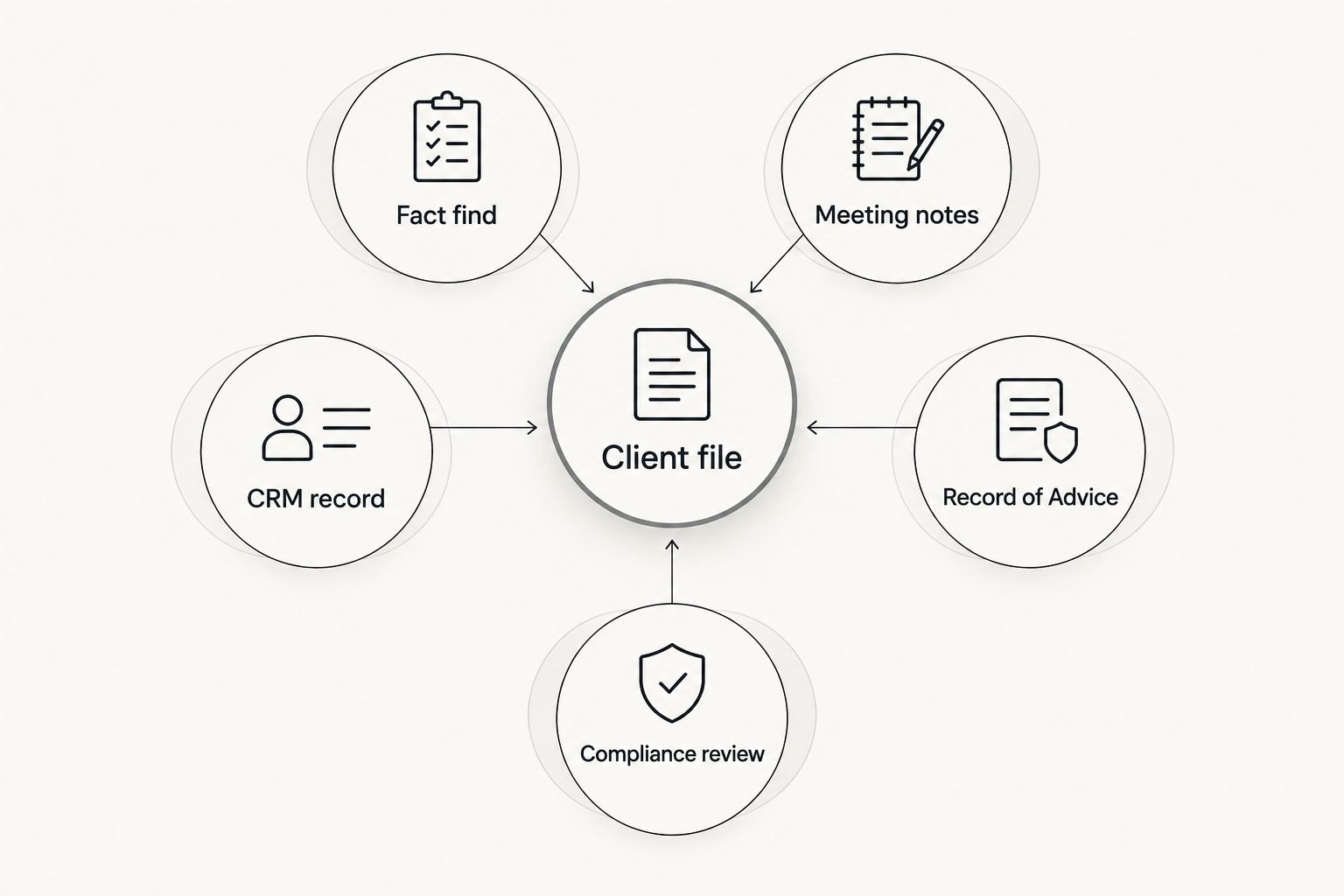
Automate meeting notes and file noting
Manual file noting is where onboarding actually breaks down — advisers write notes hours after the meeting, from memory, and the detail thins out.
- Record first meetings with client consent before anything else changes.
- Stop relying on advisers to summarise a 45-minute meeting from memory the next morning.
- Alcova runs Claude, ChatGPT and its own Operator across the meeting to generate a written file note and push it into the CRM without an adviser typing it out.
- Check that the note format matches what your compliance team already expects on file, not a generic transcript dump.
Draft the Record of Advice from meeting data, not a blank template
Once the fact find and meeting notes exist in one place, the Record of Advice draft should pull from them rather than start from zero.
- Use the fact find fields and meeting notes to pre-fill the advice document structure.
- Keep a human review step before anything goes to the client — software drafts, advisers approve.
- Flag any field the client didn't actually answer, rather than letting a template default silently fill it in.
Route the file through compliance review
Compliance review is the step that catches inconsistent onboarding before it becomes an audit finding.
- Set one compliance checklist every file must clear before advice is issued.
- Use compliance recordkeeping software for advisers to keep meeting records and file notes audit-ready in one searchable place, rather than scattered across email threads.
- Log the date each check happened against the file, not just the outcome.
Track onboarding speed across advisers
A firm-wide onboarding metric tells you more than any single adviser's opinion of the process.
- Measure days from first meeting to signed engagement, per adviser, not just as a firm average.
- Compare advisers month over month to spot who's carrying a backlog.
- Flag any file that hasn't moved since its last CRM update, rather than waiting for a client to chase it.
Comparing onboarding options for wealth management firms
| Option | Best for | Key limitation |
|---|---|---|
| Spreadsheet + email | A one- or two-adviser practice testing its process | Doesn't scale past a handful of advisers; nothing is centrally searchable |
| Generic form builder | Firms wanting a quick intake form | Rarely syncs into the CRM, creating a second, unsynced client record |
| Practice management suite (XPLAN, Intelliflo) | Firms that need onboarding built into a full practice platform | Heavier setup; often built around forms rather than meeting-driven advice |
| Alcova | Firms already using Claude or ChatGPT that want that AI layer wired into meeting notes, CRM sync and compliance records | Best suited to firms already comfortable running AI tools inside advice workflows, not a standalone form builder |
For a full breakdown ranked by how fast each option actually moves a file, see onboarding platforms ranked by speed.
“If a file needs an email search to find the fact find, compliance already has a problem.”
Common mistakes wealth management firms make with onboarding
- Building one adviser's process and assuming it scales. What works for a solo practitioner breaks the moment a second or third adviser joins.
- Letting fact find data sit in email instead of the CRM. Compliance can't audit a Gmail thread during a file review.
- Using a form builder that doesn't sync to the CRM. This creates a second, unsynced record that drifts from the real one.
- No consistent file note format across advisers. A spot-check compliance review takes twice as long when every adviser writes notes differently.
- Treating onboarding speed as a solo metric. Firm leaders who only track the average miss which specific adviser is sitting on a backlog.
See how Alcova fits your firm
Meeting notes, CRM sync and compliance records in one place.
FAQ
What is the best client onboarding software for wealth firms in 2026?
There's no single best option — a one- or two-adviser practice can run on a shared fact find and a CRM, while a multi-adviser firm needs meeting notes, CRM sync and compliance records tied together, which is where a platform like Alcova is built to sit.
Is client onboarding software worth it for a small advice practice?
For a firm under three advisers, a shared fact find template and a single CRM often covers it; the case for dedicated onboarding software gets stronger as more advisers need the same file note format.
How long do wealth firms need to keep client onboarding records?
Records of advice given to retail clients generally need to be retained for at least seven years under the Corporations Act, which is why onboarding files need to live in a searchable CRM rather than email.
Does onboarding software replace a CRM?
No — onboarding software should feed data into the CRM, not sit separately from it. Tools built around CRM sync avoid the double-entry problem that generic form builders create.
Can AI notetakers be used for compliance-sensitive onboarding meetings?
Yes, with client consent recorded before the meeting starts. The notetaker should generate a file note format that matches what compliance already expects, not a raw transcript.
What's the difference between a fact find and a Record of Advice?
A fact find captures the client's situation, goals and risk profile at intake; a Record of Advice documents the actual recommendation given, and should be drafted from the fact find and meeting notes rather than a blank template.
How do wealth firms measure onboarding speed?
Track days from first meeting to signed engagement per adviser, then compare that figure month over month across the firm rather than relying on a single average.
One last thing
The seven-year record retention requirement under the Corporations Act isn't a compliance footnote — it's the reason email-based onboarding fails wealth management firms long before anyone notices. A file note buried in a 2023 inbox is functionally gone by the time a 2026 audit asks for it. The firms that fix onboarding first fix where the file note lives, not what form the client fills in.