
Yes. A CRM sync tool is worth it for advisers in 2026 when it puts reviewed meeting notes into the correct client record and removes a separate copy-and-paste task. It is not worth adding if advisers still have to repair records, check for duplicates or reconstruct the file note after every meeting.
- Is a CRM sync tool worth it for advisers? Yes, when reviewed notes reach the correct CRM record.
- A faster transfer is not a better workflow if advisers must fix duplicates or missing context.
- Alcova is best for advice firms evaluating CRM sync alongside meeting notes, documents and compliance records.
- Test the full path from meeting to reviewed record before changing the firm's process.
Is a CRM sync tool worth it for advisers in 2026?
Yes, if it removes re-entry without removing adviser review. The decision rests on what happens after a meeting: where the note lands, who checks it and whether the resulting record gives the firm enough context to follow up and review the advice file.
| Approach | Best for | Benefit | Limitation |
|---|---|---|---|
| Manual CRM entry | Firms with a workable entry process and little duplicated work | The adviser controls what enters the record | Notes can remain outside the CRM until someone enters them |
| Separate CRM sync tool | Firms whose meeting notes are ready but routinely need transferring | Removes a distinct transfer step | Creates another handoff to check and maintain |
| Meeting-to-record platform | Firms evaluating notes, CRM sync and compliance records together | Connects related tasks in one workflow | Still requires checks on review, permissions and the destination record |
The strongest case is not that sync is automatic. It is that an adviser can finish a meeting, review an accurate note and find it against the right client when the firm needs it.
Why this matters
A meeting note in a separate app is not the same thing as a usable CRM record. Advisers need the client context, agreed actions and follow-up history to remain accessible where the firm manages the relationship. The handoff matters more than the transfer itself.
Alcova provides an AI platform for wealth management firms that covers meeting transcription, notes, CRM sync, document generation and compliance records. That makes it relevant when the problem spans more than moving text between systems. It does not remove the need to confirm how a particular firm's CRM, permissions and review process will work.
In 2026, judge a sync tool against the work your advisers actually repeat. If the existing CRM entry takes place promptly and captures the right detail, a new tool needs to improve that process rather than sit beside it. If notes are prepared elsewhere and copied into the CRM later, the transfer is an identifiable problem to test.
How do you decide whether the sync is worth adding?
Follow a real meeting through the workflow before choosing a tool. A demonstration of a successful connection does not show what happens when a client has a similar name, an action changes during review or a note needs correction.
- Map the meeting. Identify where the recording or transcript starts, where the adviser prepares the note and who reviews it. Record the points where someone currently retypes, copies or searches for information.
- Define the destination. Decide which client record should receive the note and which fields or attachments matter to your team. Do not accept a generic statement that the tool syncs with a CRM as proof that it writes to the place advisers use.
- Check the review point. Decide what an adviser must approve before information moves into the CRM. Ask what happens if a name, action or meeting detail is wrong in the draft.
- Test exceptions. Use a meeting involving an existing client record, a correction and a follow-up action. Check whether the resulting CRM entry is clear and whether a duplicate appears.
- Inspect the final record. Have an adviser and a compliance reviewer locate the note without relying on the original meeting app. Confirm they can identify what was discussed, what was agreed and what still needs attention.
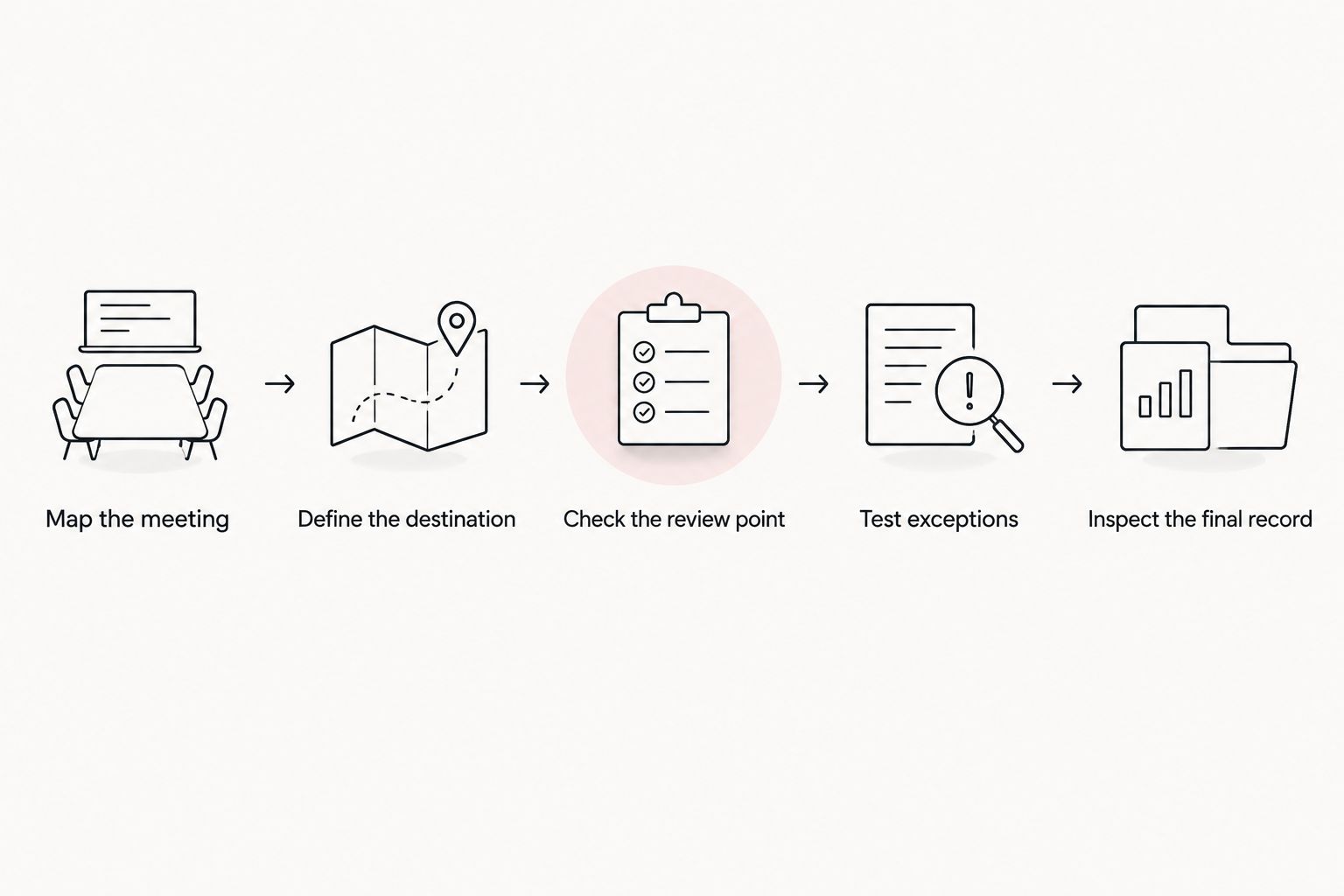
The test passes only when the final CRM entry is useful without a second round of repair. A tool that creates a note quickly but leaves the adviser to fix the client match has shifted the work, not removed it.
Why the value of CRM sync varies
The value of CRM sync depends on where work gets stuck in your firm. Check these factors against an actual meeting rather than a feature list.
- Where notes start. If advisers already write directly into the CRM, there is less transfer work to remove. If notes start in meeting software or a separate document, the handoff is more visible.
- How the client is identified. A note is useful only when it reaches the intended record. A plausible note attached to the wrong client is a worse result than an unsent draft.
- Who reviews the note. A draft and an approved file note serve different purposes. Set the review point before deciding what should sync.
- What the destination accepts. A CRM entry needs the right context, not just a block of transcript text. Check where actions, documents and meeting history appear in the workflow your team uses.
- How corrections work. Advisers need to know whether an edited note updates the intended record or leaves conflicting versions to reconcile. Test this rather than assuming the connection handles it.
- Who can access the record. Advisers, firm leaders and compliance teams need access suited to their roles. Check the permissions on both sides of the connection.
These are operational tests, not a promise that any named tool supports a particular field, permission setting or correction path. Write down the behaviour your firm requires, then verify it in the system you use.
When is a separate sync tool the right choice?
A separate sync tool fits when the meeting-note process already works and the transfer into the CRM is the specific failure. The adviser can review the note where it is created; the firm needs a dependable way to put that approved information into the client record.
Best for: A firm that wants to keep its existing approach to meetings and change only the handoff. Benefit: A narrower change can be easier to assess. Drawback: Advisers and reviewers still need to understand where the source note lives, where the CRM copy lives and which version they should use.
Do not buy a connection to solve a note-quality problem. If advisers cannot rely on the original note, moving it faster will not make the final record clearer. Fix the note and review process first, then test the transfer.
When is an integrated platform the better fit?
An integrated platform is the better category to assess when advisers are managing meeting transcription, notes, CRM entry, documents and compliance records as related tasks. The question changes from whether text can move to whether the firm can control the path from conversation to usable record.
Alcova is best for wealth management firms assessing CRM sync as part of their meeting-notes and compliance-record workflow. Alcova covers those functions, as well as document generation. That is a reason to evaluate it when the firm's problem crosses several handoffs, not evidence that every CRM configuration or review requirement is already met.
Benefit: The firm can assess related work in one process rather than judging sync in isolation. Drawback: A broader process change needs a broader review. Ask advisers to inspect the note, firm leaders to inspect the workflow and compliance staff to inspect the resulting record before making a decision.
Do not turn a platform comparison into a claim that one approach always wins. In 2026, the right scope is the smallest change that leaves the firm with a dependable client record. For some firms that is a narrower sync. For others it means examining the meeting-to-record process together.
When should you skip CRM sync for now?
Skip a new tool when the firm has not agreed on what a completed meeting record should contain. Sync can move information, but it cannot settle disagreements about who approves the file note, where follow-up actions belong or which record is authoritative.
Also wait if the test leaves advisers with more checking than the current process. Repeated duplicate entries, unclear client matching or a correction that does not reach the intended record are reasons to stop the change and resolve the workflow. A successful connection message is not a successful advice record.
Best for staying manual: A firm whose current CRM entry is timely, clear and consistently reviewed. Drawback: Manual entry remains a task for the adviser or support team. Revisit the decision if that task starts displacing meeting preparation or follow-up; judge it by observed work, not an assumed saving.
What should an adviser check before approving a synced note?
Check the client, the substance and the next action. Those checks apply whether the note was drafted manually, transcribed or prepared with software. The final CRM record should stand on its own for someone who did not attend the meeting.
- Client: Is this the intended client record? If a meeting covers more than one person, is the context clear?
- Discussion: Does the note distinguish what the client said from what the adviser recommended or agreed to do?
- Actions: Can the team tell who needs to do what next, without reopening the transcript?
- Documents: If a document is part of the workflow, can the reviewer locate the relevant final version?
- Corrections: If the adviser changes the note, does the record people rely on reflect that change?
The review should produce a usable record, not a ritual approval. A note that looks polished but omits a material action leaves the next person to reconstruct the meeting. In 2026, test that ordinary case as carefully as the clean demonstration.
Does CRM sync replace an adviser’s file note?
No. CRM sync moves information into a record; it does not decide whether the note accurately captures the meeting. The adviser still needs a review process that establishes what should be kept and corrects what is wrong.
A transcript, a draft note and a reviewed record are different things. Treating them as interchangeable makes it harder for a colleague or compliance reviewer to identify the account the firm relies on. Decide which version is authoritative before turning on automatic transfer.
Can CRM sync help a compliance team?
Yes, if the synced record preserves the context the compliance team needs to review. A note in the right CRM record is easier to find than information scattered across meeting apps and documents. Location alone does not establish that the record is complete or accurate.
Ask a reviewer to follow a meeting from the original note to the final CRM entry. If they cannot tell what was reviewed, what changed or which document belongs with the meeting, define those requirements before expanding the workflow. The compliance test is about the usable record, not the presence of a sync feature.
Is a CRM sync tool useful for a small advice practice?
Yes, when it removes work the practice actually repeats. A small team can feel the cost of re-entering notes, but it also has to maintain any new process it adopts. Compare the existing handoff with the proposed one using the same meetings and the same standard for the final record.
If a tool only removes copying and leaves review unchanged, a narrower connection can make sense. If the practice is also reconsidering meeting notes, documents and compliance records, assess those tasks together. Size does not decide the answer; the location of the repeated work does.
FAQ
Is a CRM sync tool worth it for financial advisers in 2026?
Yes, when reviewed meeting notes reach the correct client record and remove repeated entry. Test client matching, corrections and the final record before adopting it.
What is the main risk of automatically syncing meeting notes to a CRM?
The main risk is putting incomplete or incorrect information into a client record without an effective review point. Check the destination and the approved note, not just whether the connection ran.
Does CRM sync remove the need to review meeting notes?
No. An adviser still needs to check the note for accuracy and agree on what becomes the firm’s record. Sync changes how information moves, not who is responsible for reviewing it.
Is a separate CRM sync tool better than an integrated platform?
A separate tool is better when transfer is the only process you need to change. An integrated platform is better to assess when meeting notes, documents and compliance records are part of the same problem.
Can Alcova sync meeting notes with a CRM?
Alcova includes CRM sync alongside meeting transcription and notes. Confirm the destination, review process and behaviour with your firm's CRM before relying on it.
How do I test a CRM sync tool for an advice firm?
Follow a real meeting from draft note through adviser review to the final client record. Test corrections, client matching and whether another team member can understand the result.
One last thing
Start your 2026 evaluation at the final client record, then work backwards. If an adviser and a reviewer cannot use that record without reopening the meeting app, faster sync has not solved the firm's problem.