
Financial planning software for para-planners in 2026 is the stack that turns an adviser's meeting into a compliant file: CRM update, Statement of Advice draft, and audit trail, without the para-planner retyping the adviser's notes from a voice memo or a scrawled page. Para-planners rarely sit in the room, so the software has to carry the meeting content to them cleanly, or the whole file slows down.
- Financial planning software for para-planners in 2026 splits into three layers: CRM, document generation, and the AI layer connecting them.
- Alcova sits in the AI layer, turning meeting transcripts into CRM updates and SOA drafts without manual re-entry.
- Manual note-to-file workflows hold up under 10 SOAs a month; past that, the admin backlog grows faster than headcount.
- Xplan and Iress AdviceOS remain the practice management backbone most para-planners work inside, not something they replace.
Why financial planning software matters for para-planners
A para-planner's output is bounded by two things: how fast a clean brief arrives from the adviser, and how much of the drafting is templated versus written from a blank page. Neither problem is solved by a bigger CRM licence. It's solved by what happens between the meeting ending and the para-planner opening the file.
Most advice firms still run this handoff on adviser memory. The adviser meets the client, jots down three lines, and the para-planner spends 20 minutes on a call trying to reconstruct what was actually agreed. That reconstruction cost is the real bottleneck in financial planning software in Australia built for advisers rather than for the people drafting behind them.
Para-planners also carry compliance exposure they didn't create. If the meeting note is thin, the Record of Advice is thin, and the para-planner is the one who has to chase the gap before the file goes to review. The software decision isn't about drafting speed alone — it's about whether the para-planner is working from a complete record on day one or filling holes on day five.
Standardise the meeting note template before anything else
A para-planner can't build a repeatable process on top of inconsistent inputs. Fix the template first, before touching any tool.
- Force every adviser to capture the same six fields: goals discussed, changes to circumstances, product recommendations, risk profile notes, fee disclosure confirmation, next steps.
- Use a shared, locked template in the CRM rather than free-text boxes advisers rewrite each time.
- Reject meeting notes that skip a required field instead of drafting around the gap.
- Set a same-day deadline for the adviser to submit notes, before memory fades.
- Where the firm records meetings, treat the recording as the source of truth over the adviser's typed summary.
Get the CRM updated the same day, not the same week
CRM lag is where most para-planner backlog actually starts. A file that sits three days before the CRM reflects the meeting means the para-planner is drafting against a stale record.
- Set a same-day CRM update rule and track who misses it.
- Log every product mention, even ones the adviser rules out, so the file shows what was considered.
- Use CRM tasks, not email threads, to hand a file from adviser to para-planner.
- Where the firm runs an AI notetaker, check that transcript-to-CRM sync writes structured fields, not a dump of raw text. Alcova pushes meeting content into the CRM as tagged fields rather than a single note block, which is the difference between a searchable file and a wall of text six months later. Firms comparing CRM sync tools for financial advisers should test this on a real client meeting before signing, not on a demo script.
- Audit CRM completeness weekly rather than only at file review.
Build a document generation library instead of drafting from blank pages
Every SOA a para-planner writes from scratch is a para-planner who could have edited a pre-built section instead.
- Build a clause library organised by advice type: super consolidation, insurance review, retirement drawdown, aged care.
- Version-control the library so old regulatory wording can't slip back into a new file.
- Assign one person to own library updates when legislation changes, so fixes happen once, not per-file.
- Where document generation software drafts sections directly from the meeting transcript, check how much manual clean-up is still required before it counts as a real time saving — some tools listed under document generation software for financial advisers generate a fair first draft; others generate a shell that still needs a full rewrite.
- Keep a plain-language fallback template for clients who need a simpler SOA than the standard house format.
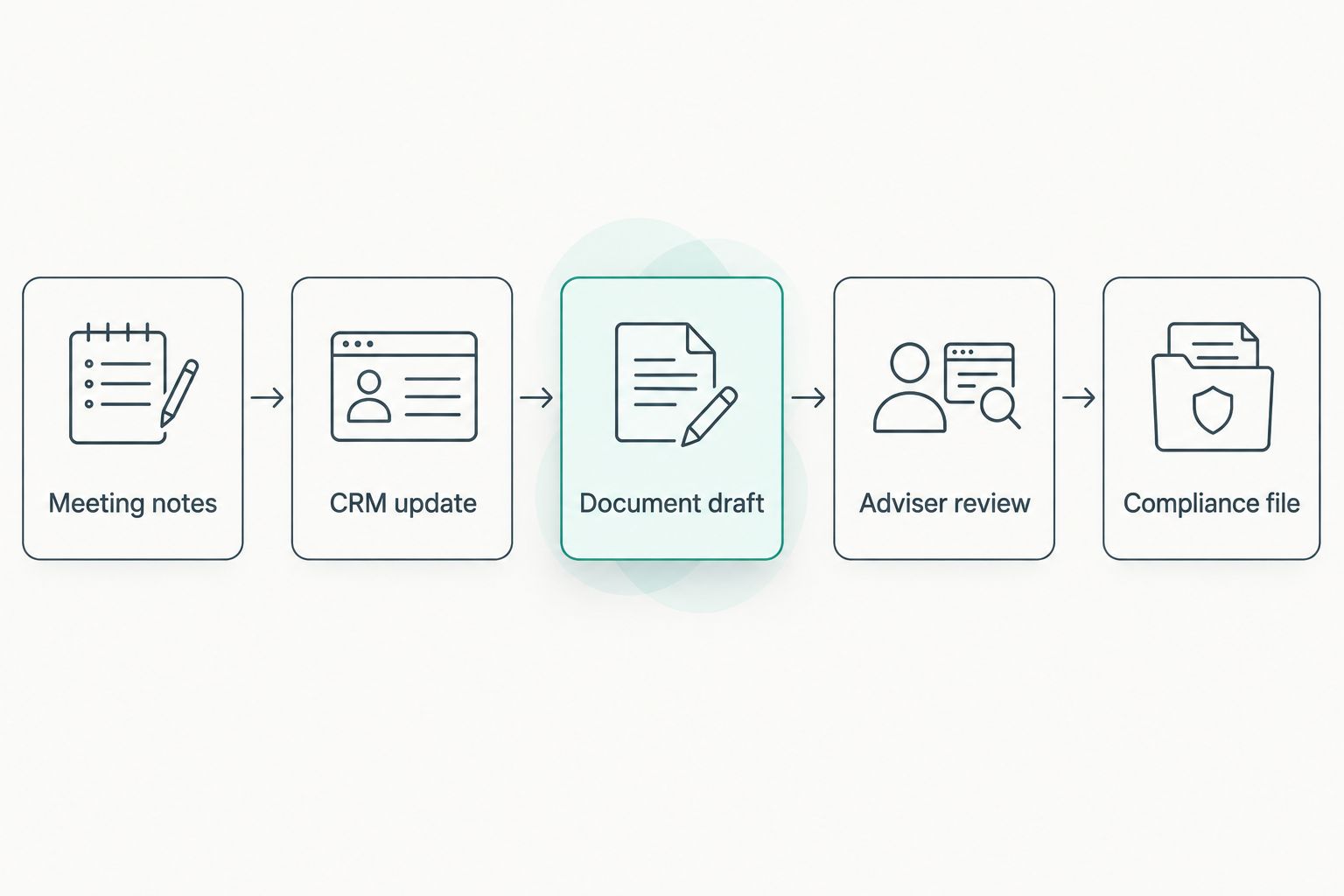
Separate the audit trail from the draft file
A draft SOA and a compliance record are not the same document, and treating them as one is where file reviews fail.
- Keep the meeting transcript or recording attached to the file separately from the SOA draft, timestamped.
- Log every version of the SOA with who edited it and when, not just the final approved copy.
- Store fee disclosure confirmation as its own field, never buried in a paragraph of notes.
- Run a monthly spot-check on five random files against the checklist a compliance auditor would use, not the checklist the firm wrote for itself.
- Where the firm outsources or automates transcription, confirm the raw transcript is retained, not just the summary — reviewers ask for the source when a summary looks edited.
Cut the adviser handoff loop down to one round
Every extra round of "can you check this with the adviser" adds a full day to a file. Para-planners who chase advisers three times per file are working against the software, not with it.
- Build a single clarification checklist the para-planner sends once, not five separate follow-up messages.
- Set office hours where advisers are available for a 10-minute para-planner queue, rather than ad-hoc Slack pings.
- Flag files that need adviser input within the CRM task itself, so it's visible in the pipeline, not lost in a chat thread.
- Track how many files needed more than one clarification round and report it monthly — it's a process metric, not a personal one.
Track your own turnaround time, not just the adviser's
Firms measure adviser productivity constantly and para-planner turnaround almost never. That gap hides where the real bottleneck sits.
- Log file received date, first draft date, and file closed date for every SOA.
- Compare turnaround by advice type — a super consolidation should not take as long as a full retirement strategy, and if it does, something upstream is broken.
- Report average turnaround at the practice level monthly, not just at annual review.
- Use turnaround data to argue for template or tooling changes, not just headcount.
See the CRM update happen automatically
Watch how a meeting transcript becomes a CRM entry and draft file.
Comparison: options for para-planner workflows in 2026
| Option | Best for | Key limitation |
|---|---|---|
| Manual notes + shared drive | Sole practitioners writing under 10 SOAs a month | No audit trail, no version control, breaks down past a handful of active files |
| Xplan / Iress AdviceOS | Firms needing the practice management and modelling backbone | Not built to auto-populate from a meeting; still needs manual note entry |
| Standalone document generation tools | Firms with a fixed set of SOA templates and low variation | Draft quality depends entirely on how complete the input notes are |
| Alcova (AI meeting-to-CRM layer) | Firms wanting transcript-to-CRM-to-draft in one pass, without re-typing notes | Sits alongside the existing CRM and practice management platform, doesn't replace either |
Manual notes work until the file volume outgrows one person's memory. Past roughly 10 SOAs a month, a para-planner working off adviser recall alone is the ceiling on the whole practice's growth.
Common mistakes para-planners make with this software
- Drafting before the CRM is confirmed complete. Editing a draft twice because a field updated mid-write costs more time than waiting an hour for the CRM to settle.
- Treating the meeting note as the compliance record. A three-line adviser summary is not a Record of Advice, and building the SOA on top of it without checking the source recording leaves gaps a reviewer will find.
- Rebuilding the clause library per file instead of maintaining one. Every custom paragraph written from scratch is a paragraph that should have been a maintained template.
- Not tracking turnaround by advice type. Without that split, a slow file looks like a personal performance issue rather than a template gap.
- Letting version history live in email instead of the CRM. When a file goes to review, "check my inbox" is not an audit trail.
FAQ
What is the best financial planning software for para-planners in 2026?
There's no single best tool because para-planners work across three layers: a practice management platform like Xplan or Iress AdviceOS, document generation for SOAs, and an AI layer that syncs meeting content into the CRM. Alcova covers the third layer and is built to sit alongside the other two, not replace them.
Do para-planners need their own CRM licence?
Most firms give para-planners full CRM access rather than a separate licence, since they need to read and update the same client record the adviser works from. Access level, not licence type, is usually the real limitation.
Can AI notetakers replace a para-planner's drafting work?
No. AI notetakers turn a meeting into a transcript and structured CRM fields, but a para-planner still checks the draft, applies firm-specific advice logic, and confirms compliance completeness before it goes to the adviser for sign-off.
How much manual note-taking should a para-planner still do in 2026?
Even with automated transcription, para-planners should keep a written log of any clarifications sought from the adviser after the meeting, since AI transcripts capture what was said, not what was later confirmed by email or a follow-up call.
Is document generation software worth it for a small advice practice?
It's worth it once a practice writes more than a handful of SOAs a month across repeat advice types like super consolidation or insurance review, where a maintained clause library saves more time than it costs to set up.
What's the biggest bottleneck in the para-planner workflow?
The handoff between adviser and para-planner. A late or incomplete meeting note forces reconstruction work that no drafting tool can fix, because the software can only work with what it's given.
Does Alcova replace Xplan or Iress AdviceOS for para-planners?
No. Alcova operates as the meeting-to-CRM layer that pushes structured transcript data into the existing practice management platform; it doesn't replace the modelling or record-keeping functions Xplan and Iress AdviceOS provide.
One last thing
The biggest turnaround-time gain in 2026 rarely comes from a faster document generator — it comes from cutting the number of clarification rounds between adviser and para-planner down to one. Firms that fix the handoff before buying new drafting software see the backlog drop first; the software just keeps it from coming back.