
Compliance software for accounting firms is the system that captures client meetings, engagement documentation, file notes and audit trails so a firm can prove what happened, when, and who signed off on it. Accounting firms carry a mixed compliance load: tax and audit obligations under the Tax Practitioners Board and ASQM 1, plus — for the growing number of firms with an in-house or aligned AFSL — Records of Advice under the Corporations Act. The two workloads need different tools, and most firms only realise that after an audit request exposes the gap.
- Compliance software for accounting firms spans spreadsheet trackers to AI tools like Alcova that generate compliance records from client meetings.
- Firms with a financial advice division need Records of Advice, file notes and CRM sync that generic practice management suites don't cover.
- Manual file noting is the free starting point; automated capture pays off once advice volume outpaces admin hours.
- Alcova fits accounting firms running or partnered with an AFSL advice arm, not firms doing tax and audit work only.
Why compliance software matters for accounting firms
Since the accountants' exemption for SMSF advice was removed in 2016, a large share of Australian accounting firms now hold their own AFSL, operate under a licensee, or refer clients to an aligned adviser. Any of those three setups creates a Record of Advice obligation that a tax-and-audit workflow tool was never built to handle.
A firm's compliance file needs to satisfy two separate reviewers: the TPB or ASIC auditor checking tax and audit workpapers, and — where advice is given — the compliance reviewer checking that a file note exists for every substantive conversation. Firms that run both service lines off one shared drive usually find the advice-related notes are the thinnest part of the file, because nobody owns capturing them in the moment.
Update your compliance process for accounting firms in 7 steps
Map your compliance obligations by service line
Start by listing what each part of the practice actually has to produce, not what you assume it produces.
- Tax: TPB Code of Conduct record-keeping, five-year minimum retention on most working papers
- Audit: ASQM 1 quality management documentation and engagement file sign-off
- SMSF and advice: Records of Advice, Statements of Advice, and file notes under the Corporations Act
- AML/CTF: customer due diligence records where the firm falls under reporting obligations
- Engagement letters: renewal and version tracking across every active client
Centralise document version control
A client file split across three drives and two inboxes is the single biggest reason firms fail a spot-check.
- One naming convention across the practice, no exceptions for senior partners
- A single source folder per client, not a folder per engagement type
- A written retention schedule matched to TPB and ASIC minimums
- Role-based access so juniors can't overwrite signed-off files
- A sign-off log showing who reviewed the file and when
Capture meeting notes and file notes for every advice conversation
This is where most accounting firms with an advice arm lose the audit trail — the phone call happens, the advice gets given, and the note gets written three days later from memory, if it gets written at all.
- Dictate a note immediately after every call, before the next meeting starts
- Use one shared template across the team so reviewers know where to look
- Timestamp every entry and store it in the client file within 24 hours
- Flag clearly whether the conversation was general information or personal advice
- Rotate spot checks so no adviser goes a full quarter without a reviewed note
An AI meeting assistant built for advice firms, like Alcova, records the call, drafts the file note against a Record of Advice template, and flags it for review — cutting the three-day lag to same-day. That's the faster path once note volume outgrows what one admin person can keep up with; it doesn't replace the underlying discipline of the process above.
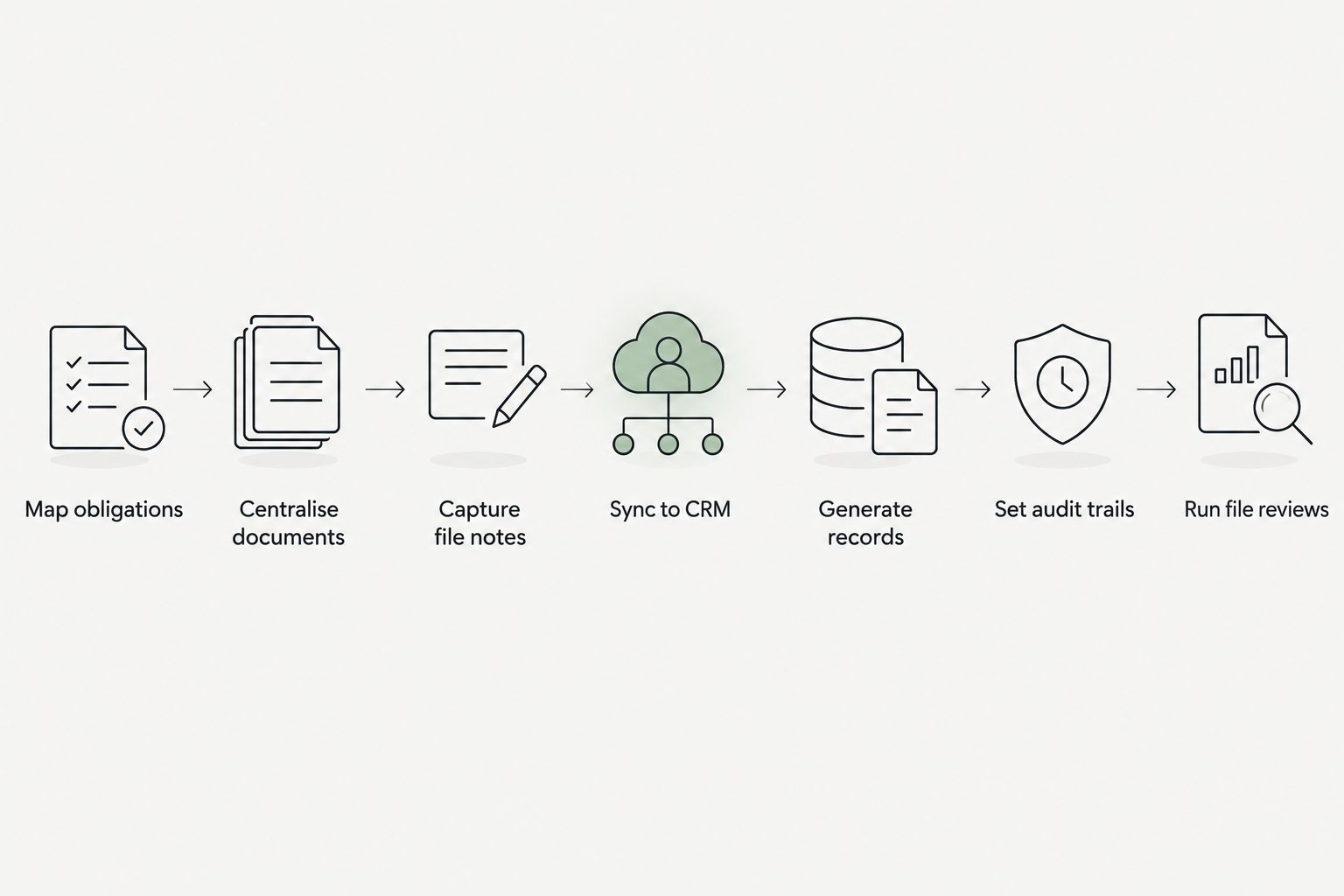
Sync conversations into your CRM or practice management system
A file note that lives in a document folder but never reaches the CRM creates two versions of the truth.
- Assign one person to re-key notes into the CRM weekly, not monthly
- Run a reconciliation check between the document store and the CRM record
- Deduplicate client records before syncing, not after
- Log who has view versus edit access to synced records
Generate compliance records and Records of Advice automatically
Manual population of a Record of Advice template is slow and inconsistent between staff.
- Build one master template covering every mandatory disclosure
- Populate it manually from the file note, checked against a disclosure checklist
- Route every completed record through a second reviewer before it's filed
- Keep a version history so amendments after the fact are visible, not silent
Firms comparing dedicated tools for this step usually land on a shortlist of compliance recordkeeping software built for advisers, since general accounting document management systems don't generate Records of Advice at all.
Set audit trails and permission controls
- Role-based access tied to job function, not seniority
- Immutable logs so a completed record can't be silently edited
- Who-viewed-what tracking on sensitive client files
- A backup cadence that matches your retention schedule, not just your IT policy
Run scheduled file reviews and quality checks
- Sample a set percentage of files every quarter, not once a year
- Check against a written TPB/ASIC-aligned checklist, not memory
- Log corrective actions and confirm they were closed out
- Rotate the reviewer so the same partner isn't checking their own files
“If a file note only lives in someone's head, it isn't a compliance record.”
Comparing your options
| Option | Best for | Key limitation |
|---|---|---|
| Spreadsheet + manual file notes | Sole practitioners, very low advice volume | No audit trail; breaks down past a handful of clients |
| Practice management suite (e.g. Karbon, XPM) | Tax and audit job tracking | Not built for Records of Advice or meeting capture |
| Dedicated AML/CTF compliance tracker | Firms with heavy customer due diligence obligations | Doesn't touch meeting notes or CRM sync |
| AI meeting assistant + compliance layer (Alcova) | Firms with an in-house or aligned AFSL advice division | Doesn't replace tax or audit workpaper software |
Verdict: for accounting firms doing tax and audit work only, a practice management suite covers the job; for firms with an advice arm, Alcova closes the Record of Advice gap that general practice software leaves open.
Check your advice-file compliance gap
See how Alcova handles Records of Advice for accounting firms with an AFSL arm.
Common mistakes accounting firms make
- Treating file notes as optional paperwork until an audit request lands, then reconstructing them from memory
- Running the advice arm off the same shared drive as tax and audit work, losing the advice-specific audit trail in the noise
- Letting days pass between a client call and the written note, so recall replaces record
- No clear handoff between the accountant who refers a client and the adviser who gives the advice, so nobody owns the compliance record
- Reviewing files once a year instead of quarterly, so a pattern of thin notes compounds before anyone catches it
FAQ
What's the best compliance software for accounting firms in 2026?
It depends on the service line. Tax and audit work is best served by a practice management suite; firms with a financial advice arm need a tool that generates Records of Advice and file notes, which is where Alcova fits in 2026.
Is Alcova suitable for accounting firms without a financial advice division?
No. Alcova is built for the advice compliance workload — meeting transcription, file notes, CRM sync and Records of Advice — not tax preparation or audit workpapers.
How is compliance software different for accounting firms vs financial advice firms?
Accounting firms answer to the Tax Practitioners Board and ASQM 1 audit standards; advice firms answer to ASIC and the Corporations Act, which requires Records of Advice for every substantive client conversation. A firm doing both needs tools covering each set.
Do accounting firms need a Record of Advice?
Only the part of the firm giving personal financial advice under an AFSL needs a Record of Advice. Pure tax and audit engagements don't trigger this obligation.
How long should accounting firms keep compliance records?
Most TPB and ASIC guidance points to a minimum five-year retention window for working papers and advice records, though firm policy should confirm the exact period for each document type.
Can AI meeting assistants replace manual file noting entirely?
They replace the writing step, not the discipline. Someone still has to review the generated note, flag whether it was general information or personal advice, and file it correctly.
What's the difference between practice management software and compliance software?
Practice management software tracks jobs, deadlines and billing across a firm. Compliance software specifically produces and stores the records regulators ask for during a review, which is a narrower and stricter job.
How much does compliance software cost for a small accounting firm?
Pricing varies by firm size, module count and whether the advice arm is included, so check current pricing directly with each vendor rather than relying on a fixed figure.
One last thing
The firms that pass a 2026 compliance review without a scramble aren't the ones with the fanciest software — they're the ones where the file note gets written the same day as the call, every time, by policy rather than by memory. Fix that one habit before buying anything.