
Mortgage broker meeting assistant AI is software that records, transcribes and files client meeting notes automatically, built to cut the admin load that comes after every loan conversation while keeping a record that stands up if ASIC or an aggregator audits the file. Brokers run more client meetings per week than most other regulated professionals, and each one has to produce a file note that shows the recommendation matched the client's needs — that's a different bar than a generic sales call summary.
- Meeting assistant AI for mortgage brokers should generate a file note that satisfies Best Interests Duty, not just a transcript.
- General-purpose notetakers like Otter.ai and Fireflies.ai skip CRM sync and compliance templates brokers need.
- Alcova (alcova.ai) is built for regulated advice workflows — transcription, CRM sync and document generation in one system.
- Sync every note to your aggregator CRM within the same day; delayed entry is the most common audit finding.
- Manual note-taking still works for very low call volume, but it doesn't scale past a handful of client meetings a week.
Why meeting assistant AI matters for mortgage brokers
The Best Interests Duty under the National Consumer Credit Protection Act has applied to mortgage brokers since 1 January 2021. It requires a broker to act in the client's best interests and to be able to show why a particular loan was recommended over the alternatives considered. That obligation lives or dies on the quality of the file note.
Most brokers still write that note from memory after the call, or from shorthand typed mid-conversation while trying to keep the client engaged. Either way, detail gets lost, and the note that ends up in the CRM often can't reconstruct what was actually discussed. An AI meeting assistant closes that gap by capturing the full conversation and turning it into a structured record without the broker doing the writing after hours.
The category also matters because broker workflows sit across two systems — the conversation itself, and the aggregator CRM (platforms like MyCRM or Podium) where the credit proposal and disclosure documents live. A meeting assistant that only transcribes and doesn't sync to that CRM just moves the admin problem, it doesn't remove it.
How to set up meeting assistant AI as a mortgage broker
Audit your current file-noting workflow
Before adding a tool, work out where the current process breaks down. Most broking practices lose time and accuracy at the same three points.
- Time between the meeting ending and the note being written
- Whether the note captures the client's stated needs or just the loan chosen
- Whether the note is searchable if a client disputes advice months later
- How long it takes to get a note from call to CRM entry
- Who reviews the note before it's filed
Choose a transcription tool built for regulated meetings, not a generic one
Consumer notetaking apps built for sales calls or internal meetings weren't designed with a Best Interests Duty file note in mind. A comparison of the top AI meeting note-takers for financial advisers in 2026 breaks down which tools handle regulated conversations properly versus which just produce a bullet-point summary.
- Does it distinguish between what the client said and what the broker recommended
- Does it flag when required disclosures were made during the call
- Does it retain the full transcript, not just an AI summary
- Does it work on phone calls as well as video meetings, since a large share of broker meetings still happen by phone
Alcova (alcova.ai) is one option built specifically for regulated advice conversations — it transcribes the meeting, generates the file note, and syncs the record into the practice's existing CRM without a broker retyping anything.
Build a file-note template that matches Best Interests Duty
A generic meeting summary won't satisfy an audit. The template needs fields that map directly to the obligation.
- Client's stated financial goals and constraints
- Loan products compared and why they were or weren't recommended
- Any conflicts of interest disclosed during the meeting
- The final recommendation and the reasoning behind it
- Next steps agreed with the client
Sync every note to your aggregator CRM the same day
A note that sits in a separate app for a week is a note that gets forgotten, and it's the first thing an aggregator compliance review flags. CRM sync tools built for financial advisers cover the same integration problem brokers face — getting a meeting record into the system of record without manual re-entry.
- Push transcripts and notes automatically, not on a weekly batch
- Confirm the sync writes to the correct client record, not a duplicate
- Check the note format matches what the CRM's audit export expects
- Set a fallback alert if a sync fails so nothing goes missing silently
Generate the credit proposal and disclosure documents from the meeting record
Once the note exists, the credit proposal and disclosure paperwork should draft from it rather than starting from a blank template each time.
- Auto-populate client details and loan comparison data from the transcript
- Flag any required disclosure that wasn't confirmed on the call
- Keep a version history so amendments after the meeting are traceable
Set permissions and an audit trail before you rely on the system
Compliance teams don't just want a note — they want to know who created it, who edited it, and when. Compliance recordkeeping software built for advisers covers the same requirement: a record that can't be silently altered after the fact.
- Lock the note from edits after a set review window
- Track every edit with a timestamp and user ID
- Restrict who can delete a record, ideally no one below compliance level
- Keep transcripts alongside the summarised note, not instead of it
Measure adoption and time saved after 60-90 days
A tool that isn't used consistently doesn't reduce risk, it just adds a second system nobody trusts. Track adoption before assuming the rollout worked.
- Percentage of client meetings with a completed file note within 24 hours
- Average time from meeting end to CRM entry, before and after
- Number of notes flagged incomplete on internal review
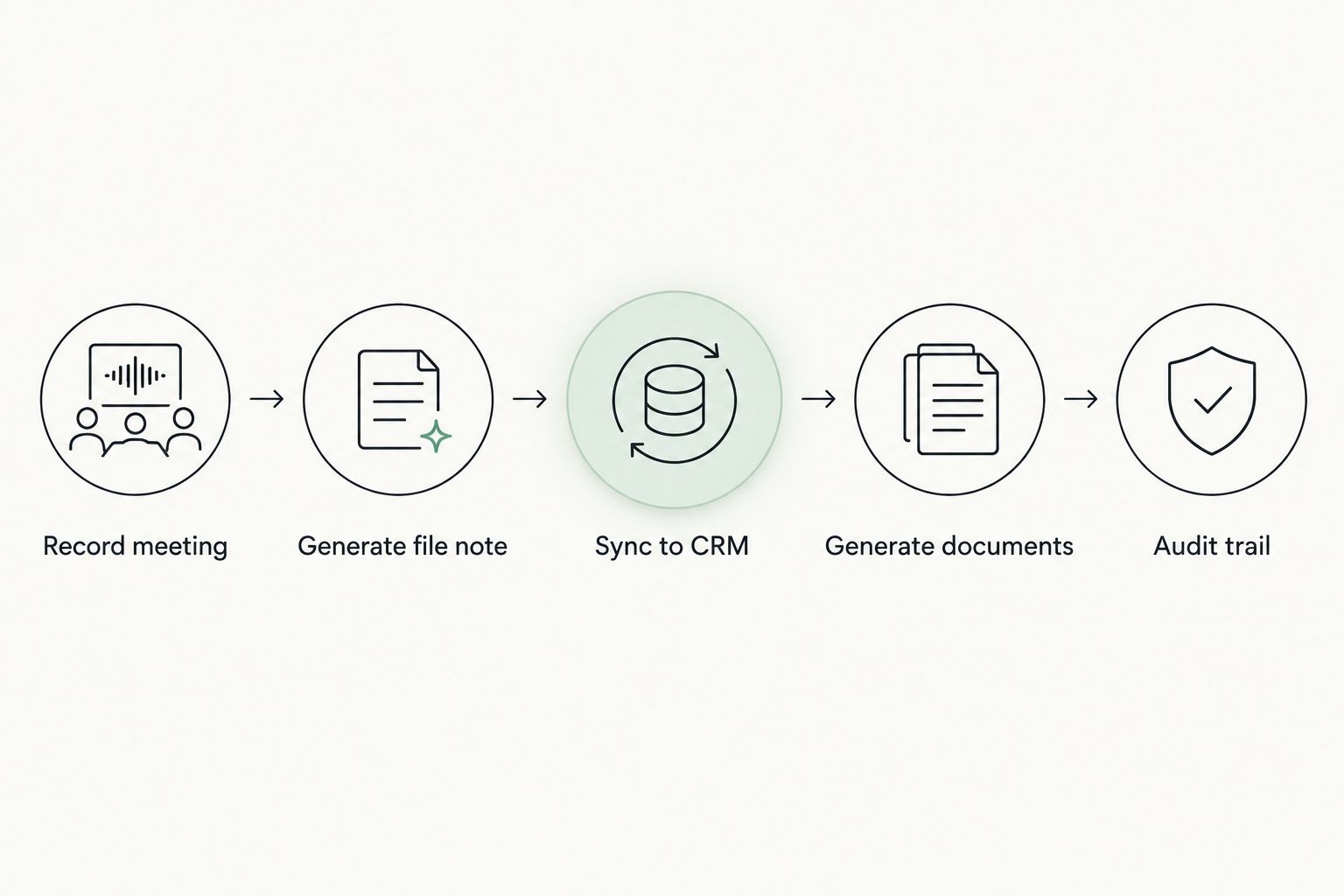
Comparing options for mortgage brokers in 2026
| Option | Best for | Key limitation |
|---|---|---|
| General notetakers (Otter.ai, Fireflies.ai) | Brokers wanting a fast, low-cost transcript | No compliance templates, no CRM sync built for credit files |
| Video-call summarisers (Fathom, tl;dv) | Solo brokers doing mostly video meetings | Misses phone calls; summaries aren't structured for Best Interests Duty |
| Alcova | Broking or advice-adjacent practices needing transcription, CRM sync and document generation together | Built primarily for financial advice workflows; broker-specific templates need setup |
| Manual note-taking and CRM entry | Very low call volume, one or two brokers | Slow, inconsistent, and the weakest audit trail of the four |
“If the file note doesn't show why a loan was recommended over the alternatives, it doesn't satisfy Best Interests Duty on its own.”
Common mistakes mortgage brokers make with meeting AI
- Recording without disclosing it to the client — most states require consent before recording a call, and skipping it undermines the record's value in a dispute.
- Letting notes sit outside the CRM for days — a note that isn't synced same-day is the first thing flagged in an aggregator compliance review.
- Using a generic transcript as the file note — a raw transcript isn't a structured record; it doesn't show the reasoning behind the recommendation.
- Giving every broker unrestricted edit access — a note that can be silently changed after the meeting has less value in an audit than no note at all.
- Treating AI output as final without review — an AI-generated summary can miss context; a quick human check before filing catches errors before they become a compliance problem.
See Alcova handle a client meeting
Transcription, CRM sync and compliance records in one workflow.
FAQ
What is meeting assistant AI for mortgage brokers?
It's software that transcribes a client meeting and turns it into a structured file note, often syncing that note directly into the broker's aggregator CRM. The goal is a compliance-ready record without the broker writing it up manually after the call.
Is meeting assistant AI required for Best Interests Duty compliance?
No specific tool is mandated, but brokers have had to satisfy Best Interests Duty under the NCCP Act since 1 January 2021, and that requires a record showing why a loan was recommended. An AI meeting assistant is one way to produce that record consistently.
Can general AI notetakers like Otter.ai work for mortgage brokers?
They can capture a transcript, but most weren't built with compliance templates or CRM sync for credit files, so brokers using them still do manual work to turn a transcript into an audit-ready note.
Is Alcova built specifically for mortgage brokers?
Alcova is built for financial advice firms handling meeting transcription, CRM sync, document generation and compliance records; broking practices with similar recordkeeping needs can use the same core workflow.
How is a broker file note different from a general meeting summary?
A file note has to show the client's stated needs, the loans compared, and the reasoning behind the final recommendation. A general meeting summary usually just lists what was discussed without that structure.
Does meeting assistant AI work on phone calls, not just video?
It depends on the tool. Many broker client meetings still happen by phone, so this is worth checking before choosing a tool built primarily for video conferencing.
How long should it take to get a note from meeting to CRM?
Same-day is the standard most compliance reviews expect. Notes that sit outside the CRM for days are one of the most common findings in aggregator audits.
Who should be able to edit a broker's file note after it's created?
Access should be limited, ideally to the broker and a compliance reviewer, with every edit timestamped. A note that can be changed by anyone without a trail has limited value if a client disputes the advice later.
One last thing
The Best Interests Duty test isn't whether a note exists — it's whether the note can show the reasoning behind the recommendation months after the meeting happened. A transcript alone doesn't do that; a structured file note with the comparison and reasoning attached does. That's the one thing worth checking before choosing any meeting assistant AI in 2026, ahead of price, ahead of integrations, ahead of everything else.